
You can launch an online store without burning through your savings.
But many first-time founders make one expensive mistake: they treat the website as the whole business.
It isn’t.
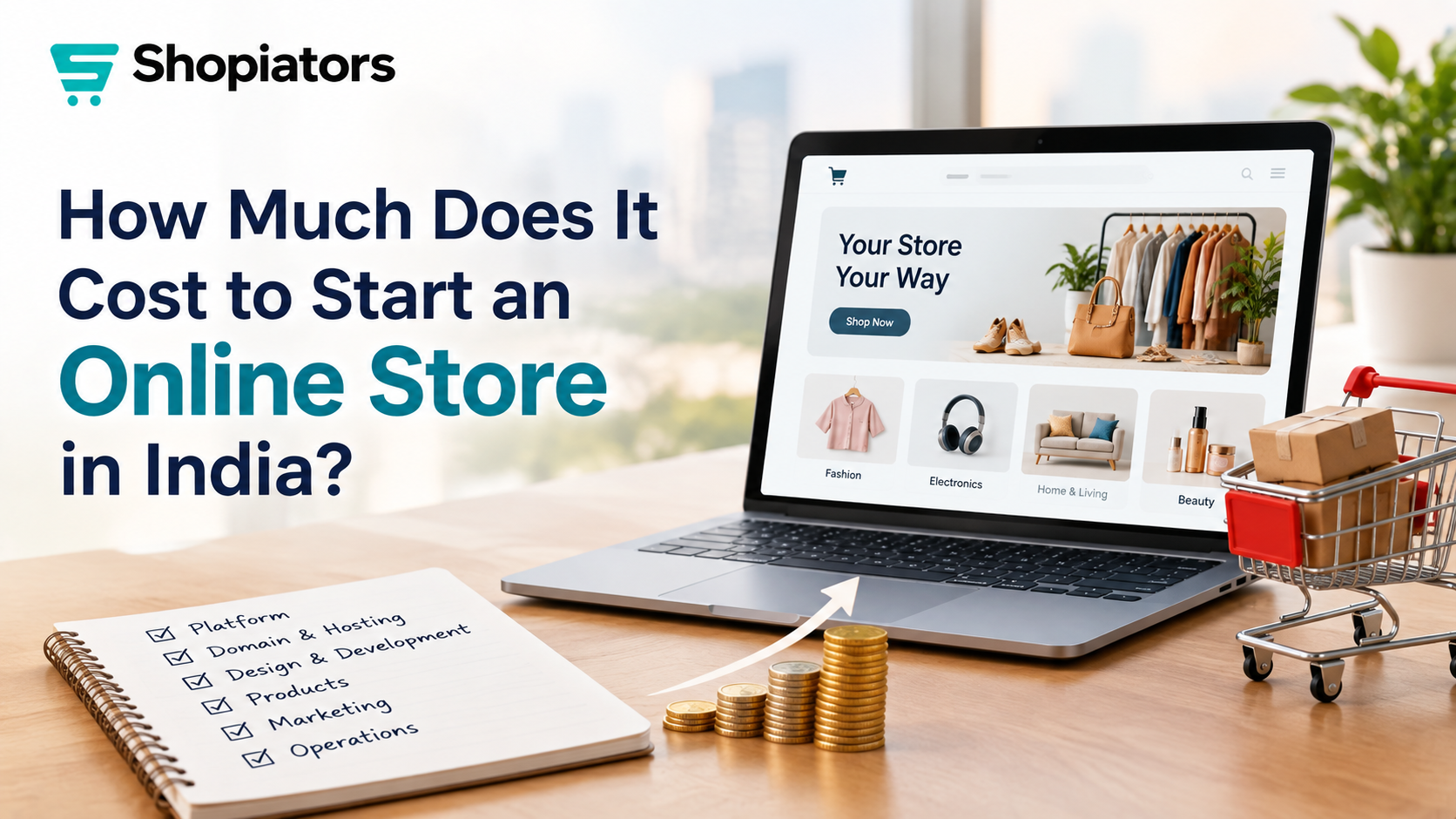
Your domain is one expense. The ecommerce platform is another. Then come payments, product photography, packaging, shipping, apps, marketing and, sometimes, development. A store that looks affordable on paper can become surprisingly expensive once everything needed to operate it is added.
So, what is the realistic cost to start online store India?
There is no single number. Your budget depends on what you sell, how much you can manage yourself and how sophisticated the store needs to be from day one.
India’s ecommerce opportunity is worth budgeting for
The timing is interesting.
IBEF reports that India had around 290 to 300 million online shoppers in 2025, with Tier 2 and smaller cities accounting for about 65% of incremental shoppers. It also reports that India’s ecommerce industry was valued at approximately US$125 billion in 2024 and is projected to reach US$345 billion by 2030.
That does not mean every new store will succeed.
It does mean the customer base is getting larger.
Your job is to enter that market without spending money in places that do little for sales.
Where does your ecommerce budget actually go?
Think of your launch budget as several smaller bills rather than one giant website invoice.
| Cost area | What you may need |
| Ecommerce platform | Store, hosting and commerce features |
| Domain | Branded website address |
| Design | Theme, branding and customization |
| Payments | Gateway and transaction charges |
| Product content | Photography, video and copy |
| Shipping | Packaging and delivery |
| Marketing | SEO, ads, creators or social media |
| Development | Custom features and integrations |
Inventory is separate.
So are taxes, registrations, professional services and other business-specific expenses.
That distinction matters because a founder might say, “My website cost ₹30,000,” while the actual launch investment is several times higher.
Your platform choice can change the math
Hosted ecommerce platforms are popular for one simple reason: they remove a lot of technical maintenance.
Shopify, for example, currently lists its Basic plan in India at ₹1,499 per month when billed yearly. The monthly price is ₹1,994. Shopify also lists a 2% fee for third-party payment providers on Basic.
That gives you a useful benchmark when evaluating an Ecommerce Platform India option.
But do not compare platforms using subscription price alone.
Look at:
- Payment charges
- App costs
- Theme expenses
- Development requirements
- Hosting and security
- Shipping integrations
- Support
- Scalability
A cheaper monthly plan can become expensive if you constantly need workarounds or developers.
Payment fees become real as sales grow
Payment processing may barely register when you receive your first few orders.
Then sales pick up.
Razorpay currently lists standard payment gateway pricing at 2% plus GST per transaction and says the charge covers payment methods including cards, UPI, wallets and net banking.
Suppose your store processes ₹5 lakh in payments.
A 2% fee alone represents ₹10,000 before GST.
That is why I would calculate platform and payment costs against your expected sales volume, not just your first month’s budget.
Small percentages have a funny habit of becoming large numbers.
Where should you spend more?
Not on everything.
Spend where customers notice the difference.
A strong first store should have:
- Clear product photography
- Mobile-friendly pages
- Fast navigation
- Useful product descriptions
- Familiar payment methods
- Transparent shipping information
- Easy-to-find return policies
- Reliable customer support
- Analytics and conversion tracking
Fancy animations can wait.
A shopper who cannot understand what you sell, what it costs or when it will arrive is unlikely to care how beautiful your homepage looks.
Can you start with a smaller budget?
Yes, especially when you are validating a new idea.
Start with your best products instead of building a huge catalog nobody has tested. Use a good existing theme rather than paying for every custom element. Handle photography or content internally when you can maintain professional quality.
Creators can take an even leaner route. An Ecommerce Platform for Creators can provide the core selling infrastructure without forcing you to build everything from scratch.
An AI Ecommerce Website Builder can also reduce repetitive setup work when creating store pages, product content and basic structure.
The goal is simple: reduce setup time without compromising the buying experience.
What about Shopify alternatives in India?
Compare them.
Not because one platform is automatically better, but because your business model may suit another approach.
When researching Shopify Alternatives India, ask:
Can I accept the payments my customers prefer?
How much customization will I realistically need?
Who handles security and maintenance?
Can the platform connect with shipping, analytics and marketing tools?
What happens when my order volume doubles?
What will I actually pay after apps, payment fees and development?
That last question is often the most revealing.
Don’t spend your entire budget building the store
Suppose you have ₹50,000 available.
I would not put ₹45,000 into website development and leave ₹5,000 for everything else.
Your store needs customers.
Reserve money for product content, packaging, testing and customer acquisition. The exact split depends on your business. A fashion brand may need better photography. A digital product business may need almost no fulfillment budget. A food brand may need more packaging and logistics.
Build according to how you make money.
The cheapest store is not always the cheapest option
Saving money is sensible.
Cutting costs that directly affect trust and usability is not.
Your first store does not need enterprise-level complexity. It needs to make buying easy, work reliably on mobile devices and give you enough data to understand what customers do next.
Start with what you need.
Measure what happens.
Then invest where the evidence points.
That is a much healthier way to control the cost to start online store India than trying to predict every future requirement before making your first sale.
FAQs
How much does it cost to start an online store in India?
There is no fixed figure. Platform, domain, inventory, product content, payments, shipping, marketing and development can all affect the final investment.
Is Shopify expensive in India?
Shopify’s Basic plan currently starts at ₹1,499 per month with annual billing. Additional platform, payment, app and development costs should be included in your calculation.
What is an overlooked ecommerce cost?
Customer acquisition. Building the website gets you online; attracting qualified shoppers requires ongoing investment.
Can I start without coding?
Yes. Hosted ecommerce platforms and no-code tools let businesses launch without developing their own underlying infrastructure.
Should I build a custom store immediately?
Usually, only when your business requires functionality that standard ecommerce tools cannot provide. For a new brand, proving demand first can be the more sensible investment.

Yogesh
Yogesh Khasturi is the Founder of Webiators Technologies and Shopiators. With 10+ years of experience in ecommerce, Shopify, Magento, SEO, CRO, and AI-powered commerce solutions, he has helped businesses worldwide build, optimize, and scale successful online stores. He regularly shares practical insights on ecommerce growth, AI search optimization (GEO), digital commerce trends, and online business strategy.