
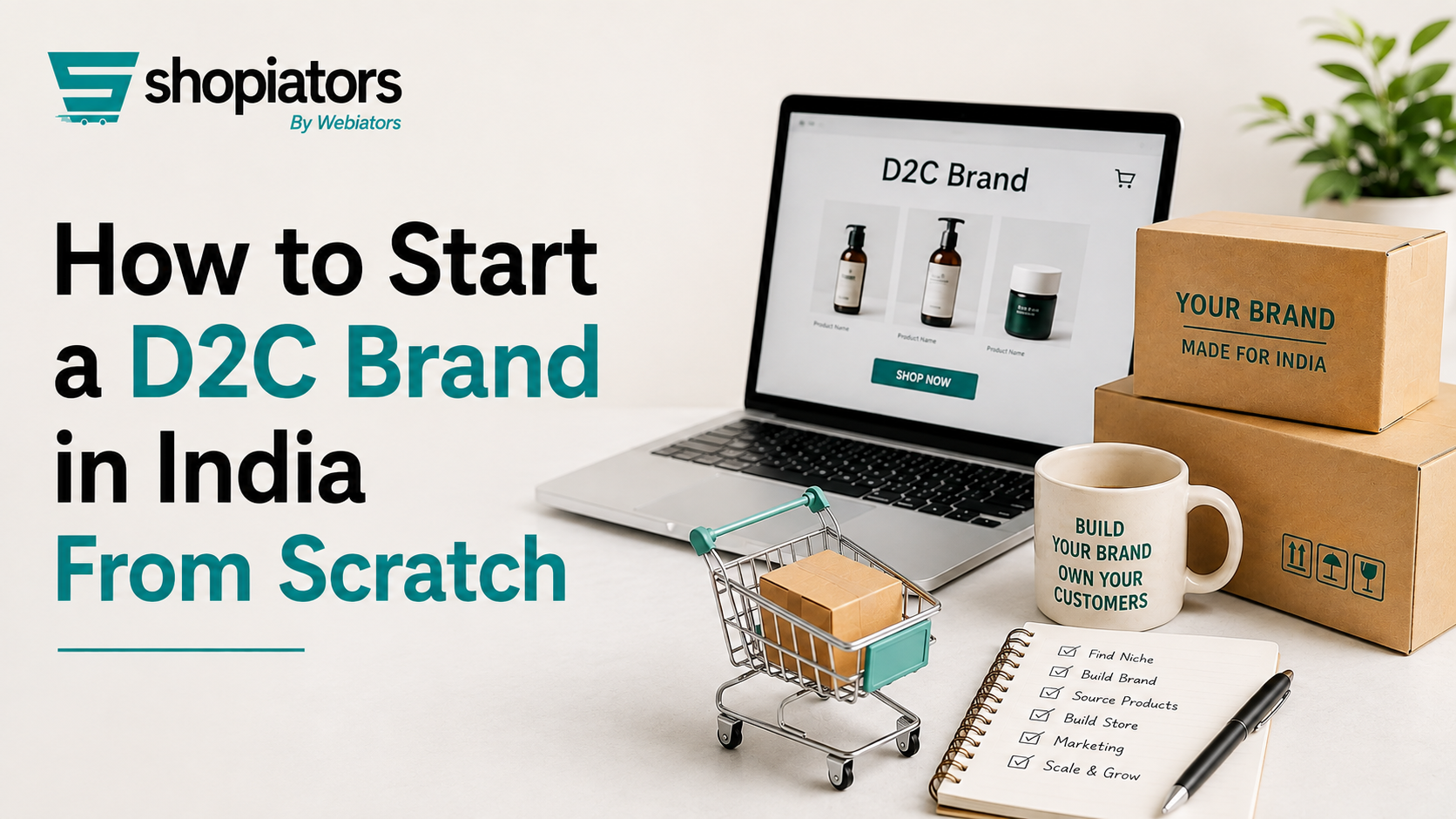
You have a product idea. You can already see the packaging, the Instagram page, maybe even the first order notification.
Then reality kicks in.
Who will buy it? How much should you invest? Which platform should you use? How will you compete with brands that already have thousands of customers?
If you want to start D2C brand India from scratch, you do not need to solve everything on day one. You need to make the right decisions in the right order. Start with the customer, validate the product, build a credible store, and scale only after the numbers give you a reason to.
Here is the practical path I would follow.
1. Find the Problem Your Brand Will Own
Do not begin with, “What can I sell?”
Begin with, “What problem can I solve?”
That small change can completely alter your business strategy.
Suppose you want to enter skincare. “Skincare products for everyone” is difficult to position. “Simple skincare for Indian men with sensitive skin” gives you a specific customer, problem, and message.
Research before investing.
Read marketplace reviews, Reddit conversations, social media comments, competitor reviews, and search queries. Speak with potential customers when possible. Pay particular attention to complaints that appear repeatedly.
Look for:
- Problems existing products fail to solve
- Features customers wish they had
- Complaints about price or quality
- Frustrations with buying experiences
- Customer groups that appear underserved
Your first product does not need to change the world.
It needs to make someone’s life easier.
2. Test the Idea Before Buying a Mountain of Inventory
One of the costliest D2C mistakes is ordering too much stock before knowing whether anyone wants it.
Start learning.
Use a small production run, prototype, preorder, landing page, or basic online store to test genuine demand. Your goal is not to create a perfect brand immediately. Your goal is to collect evidence.
Watch what potential customers actually do.
| Signal | What it can reveal |
| Page visits | Interest |
| Add-to-carts | Purchase intent |
| Checkout starts | Serious consideration |
| Completed orders | Validated demand |
| Repeat purchases | Product satisfaction |
| Customer questions | Buying objections |
There is an important difference between someone saying, “This looks great,” and someone entering their payment details.
The second one pays your bills.
3. Put the Business on Solid Ground
Once your idea begins showing traction, take care of the fundamentals.
Choose a suitable business structure based on your circumstances and obtain professional guidance where needed. Depending on your business, you may need to address GST, invoicing, taxation, trademarks, product-specific licenses, consumer protection requirements, and accounting.
If eligible, you can also explore DPIIT recognition through Startup India and the benefits available to qualifying startups.
Do this early.
Compliance is rarely exciting, but discovering a problem after your business starts scaling is considerably less exciting.
4. Build a Store That Sells, Not Just a Store That Looks Good
Your website is your digital salesperson.
A polished homepage is nice. A product page that answers every important buying question is far more valuable.
When someone lands on a product page, they should quickly understand:
- What the product is
- Who it is for
- Which problem it solves
- What makes it different
- How much it costs
- When it will arrive
- What happens if they want a return
Your choice of Ecommerce Platform India should support these requirements without making everyday management unnecessarily complicated.
Look for practical features such as product management, inventory control, payment integration, shipping tools, analytics, mobile optimization, discounts, and SEO functionality.
If you want to reduce technical dependency during setup, an AI Ecommerce Website Builder can make launching and managing the storefront considerably simpler.
5. Make Checkout Feel Effortless
You have done the hard work of getting someone to the checkout.
Do not lose them there.
Indian shoppers are accustomed to fast digital payments, particularly UPI. Your store should support familiar payment methods and keep the checkout process straightforward.
Show the final price clearly.
Give realistic delivery estimates. Avoid unnecessary fields. Explain returns and refunds before customers have to hunt for them.
Also consider customers outside India’s largest cities. Your ecommerce experience should work just as well for someone ordering from Jaipur, Kochi, Indore, Guwahati, or a smaller town.
A D2C brand should not quietly assume that every customer lives ten minutes from a fulfillment center.
6. Give Customers Reasons to Trust You
A new brand has an immediate disadvantage.
Nobody knows you yet.
Your website has to bridge that trust gap without making exaggerated promises. Use genuine product photographs, useful specifications, customer reviews, clear policies, accessible contact information, FAQs, and a straightforward brand story.
Do not hide important information behind clever copy.
If shipping takes five days, say five days.
If a product has limitations, explain them.
Honesty can feel less glamorous than marketing, but it is far more useful for building repeat customers.
7. Get Your First 100 Customers and Study Them
Your first customers are not just buyers.
They are research data with opinions.
Ask what convinced them to purchase. Find out what nearly stopped them. Notice which products attract attention and which questions repeatedly appear before checkout.
Start with one or two acquisition channels rather than spreading your budget everywhere.
Depending on your audience, you could test:
- Instagram and short-form video
- Google Search
- Creator collaborations
- SEO content
- Email marketing
- Referral campaigns
- Paid advertising
Then measure customer acquisition cost against your margins.
Revenue can look impressive while profitability quietly disappears.
8. Scale the Winners, Not Your Ego
Once sales become predictable, improve what is already working.
Strengthen your product pages. Negotiate supplier pricing. Improve fulfillment. Automate repetitive tasks. Build retention campaigns. Expand successful products before filling your catalog with products nobody requested.
Your technology should grow with you too.
Choosing the Best Ecommerce Website Builder becomes more important as orders, customers, products, and marketing channels multiply. You want flexibility without turning every routine update into a development project.
If you are still researching how to start an online store, remember that launching is only the beginning.
The real business starts when strangers become customers, customers become repeat buyers, and your numbers prove that the model can scale.
Start Small. Prove Demand. Then Scale.
To start D2C brand India successfully, you do not need a massive catalog or an enormous advertising budget.
You need clarity.
Know the customer. Solve a real problem. Validate demand before overspending. Build a store that earns trust. Watch your numbers closely.
Then grow what is already working.
That is how a product idea turns into a D2C brand people remember, trust, and buy from again.
Read Also: How to Sell Jewellery Online in India Without a Shop
FAQs
- How much money is needed to start a D2C brand in India?
There is no fixed amount. Your costs depend on product development, inventory, packaging, compliance, technology, fulfillment, and customer acquisition.
- Can I start a D2C brand without manufacturing products?
Yes. Depending on your category, private labeling, contract manufacturing, and sourcing models can help you launch without owning a manufacturing facility.
- Do I need an ecommerce website immediately?
Not necessarily. You can validate demand through smaller channels first, then build a dedicated store as your customer base develops.
- Is a Shopify-style ecommerce platform suitable for D2C brands?
Yes, when it provides the features your business needs for payments, shipping, inventory, analytics, mobile shopping, integrations, and store management.
- What should I measure after launching?
Focus on conversion rate, customer acquisition cost, contribution margin, repeat purchase rate, retention, and customer feedback. Website traffic alone does not indicate a healthy business.

Yogesh
Yogesh Khasturi is the Founder of Webiators Technologies and Shopiators. With 10+ years of experience in ecommerce, Shopify, Magento, SEO, CRO, and AI-powered commerce solutions, he has helped businesses worldwide build, optimize, and scale successful online stores. He regularly shares practical insights on ecommerce growth, AI search optimization (GEO), digital commerce trends, and online business strategy.