
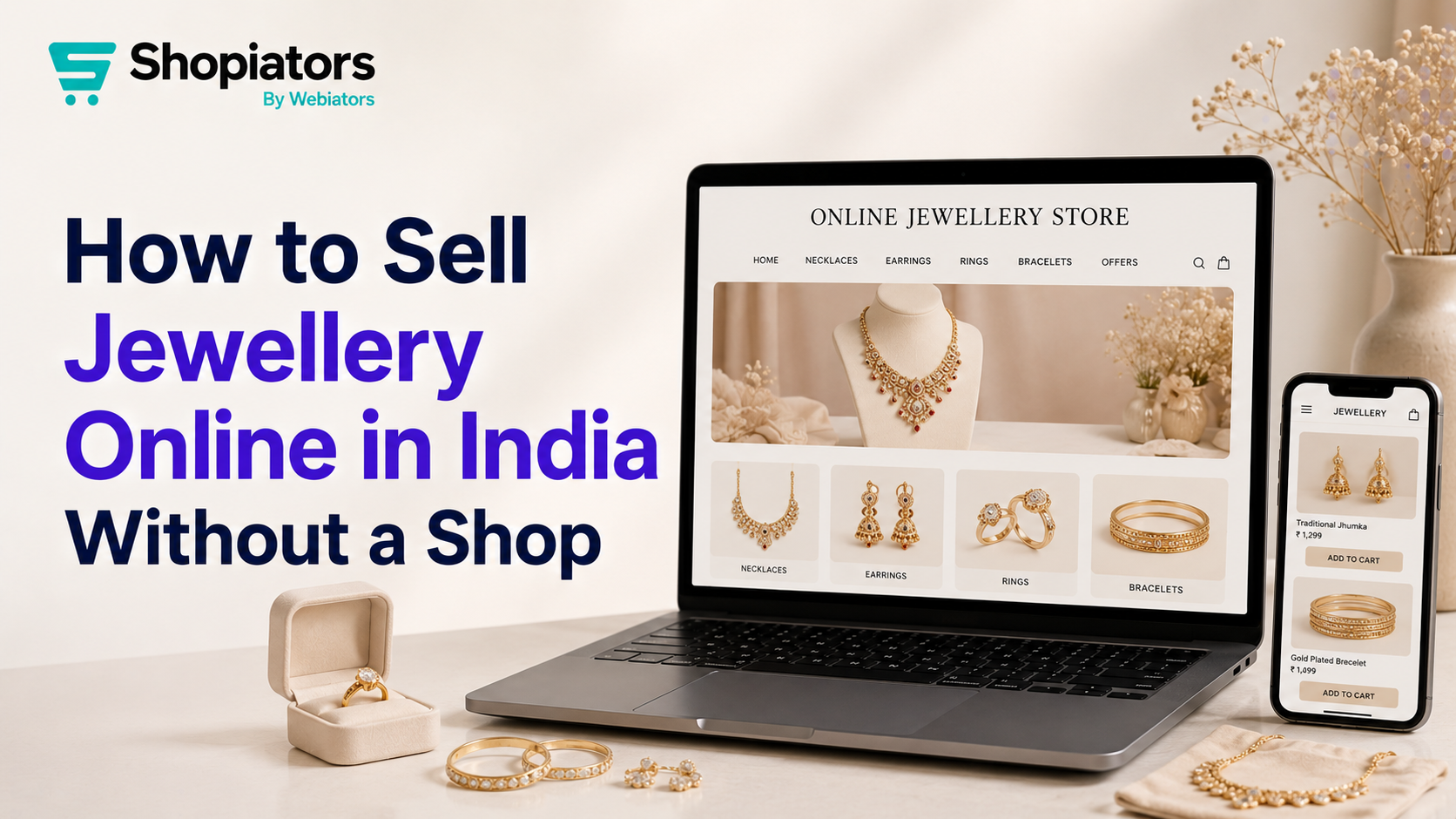
You have jewellery ready to sell, but there is one problem: you do not have a shop.
Rent is expensive. Interiors cost more than expected. Security, staff, electricity, inventory, and daily operating costs can quickly turn a promising jewellery idea into a financial burden.
But a physical showroom is no longer the only way to build a jewellery business.
You can sell jewellery online in India from a home workspace, small studio, or even a spare room. Your website becomes the storefront. Social media brings shoppers in. Shipping takes orders to customers across the country.
The trick is not simply putting products online. You need to create enough trust for someone to buy jewellery from a brand they have never visited.
Can You Sell Jewellery Online Without a Physical Shop?
Absolutely.
An online jewellery business needs a few essentials: products, a professional storefront, payment options, reliable fulfilment, customer support, and a clear brand identity.
You do not have to invest thousands of dollars in a retail location before testing whether customers actually want your products.
A hosted ecommerce platform can take care of much of the technical foundation, including website hosting, product management, checkout, and store administration. That lets you concentrate on what actually grows the business: choosing products, attracting customers, and creating a memorable buying experience.
1. Choose a Specific Jewellery Niche
Starting with “all types of jewellery” sounds ambitious. In practice, it can make your brand forgettable.
Choose a clear product direction first.
You could focus on:
- Artificial jewellery
- Handmade jewellery
- Silver jewellery
- Oxidized jewellery
- Bridal jewellery
- Minimal everyday pieces
- Personalized jewellery
- Fashion jewellery
- Traditional Indian designs
- Jewellery for gifting
Think about the person you want to attract.
A customer searching for delicate office jewellery has different expectations from someone shopping for a bridal necklace set. Your product selection, photography, pricing, website design, and content should reflect that difference.
A focused niche also makes advertising and SEO considerably easier.
2. Build a Website That Removes Buying Doubts
Jewellery is difficult to sell online for one simple reason: customers cannot touch it.
They cannot feel the finish, check the weight, or hold an earring against their face. Your website has to provide those answers instead.
Every important product page should include:
- Clear product photographs
- Multiple viewing angles
- Material details
- Dimensions
- Weight, where relevant
- Available variations
- Care instructions
- Delivery information
- Return and exchange policies
- Customer reviews
Avoid descriptions that sound impressive but say very little.
“Elegant premium necklace” tells me almost nothing.
“Gold-plated necklace with a 16-inch chain and adjustable clasp” helps me decide.
That difference matters.
A Best Ecommerce Website Builder should make it simple to add, update, and organize this information without forcing you to depend on a developer for every small change.
3. Offer Payment Options Indian Shoppers Recognize
Checkout friction can kill a sale that was already 90% complete.
Indian customers are familiar with payment methods such as UPI, credit and debit cards, net banking, wallets, and cash on delivery, depending on the merchant and payment provider.
Give shoppers suitable choices rather than making everyone follow the same payment route.
Cash on delivery can also help new brands overcome hesitation. However, it comes with a practical challenge: refused or unclaimed orders can increase shipping costs.
Use order confirmation messages, accurate delivery estimates, and sensible COD policies to reduce unnecessary losses.
4. Turn Social Media Into Your Digital Showroom
Your website may be where customers purchase, but social media is often where they discover you.
Jewellery works particularly well with visual content because customers want to see how a piece actually looks when worn.
Do not only photograph earrings on a plain background.
Show them with a saree.
Show them with office wear.
Show how a necklace looks at different lengths.
Create short videos demonstrating size, movement, shine, packaging, and styling.
Useful content ideas include:
- Jewellery styling tips
- New collection reveals
- Festive looks
- Gift suggestions
- Customer reviews
- Behind-the-scenes content
- Jewellery care advice
- Packaging videos
- Outfit and jewellery combinations
Not every post needs a “Buy Now” message.
Sometimes helping someone choose the right earrings does more for your brand than another product advertisement.
5. Make Packaging Part of the Experience
Your customer’s first physical interaction with your brand happens when the parcel arrives.
Make it count.
Jewellery needs protective packaging, especially when pieces contain delicate chains, stones, clasps, or intricate detailing. But protection does not have to mean throwing everything into a generic box.
Use packaging that reflects your brand.
Before launching, test the entire fulfilment process yourself:
- Place a test order.
- Check the confirmation message.
- Pack the jewellery.
- Test the shipping label.
- Track the parcel.
- Inspect the package after delivery.
- Review the unboxing experience.
You will spot problems much faster as a customer than as the person running the store.
6. Use SEO to Bring in High-Intent Shoppers
You do not want your website to depend entirely on paid advertising.
SEO can help customers discover your products when they are already searching for something specific.
Instead of targeting only “jewellery,” build content around searches such as:
- Artificial jewellery online India
- Silver earrings for women
- Handmade jewellery online
- Oxidized jewellery online
- Bridal jewellery sets
- Minimal jewellery for women
- Jewellery gifts for women
Create useful category pages, product descriptions, buying guides, styling articles, and FAQs around these searches.
This also gives search engines more context about what your business sells and who it serves.
An AI Ecommerce Website Builder can simplify parts of the store-building process, allowing you to spend less time dealing with technical setup and more time improving your catalogue and customer experience.
7. Build Trust Before You Chase Scale
A customer may happily spend ₹500 on a new jewellery brand after seeing convincing reviews, clear policies, quality photographs, and transparent product information.
They may hesitate at ₹5,000.
That is normal.
Trust becomes increasingly important as the order value rises.
Make these details easy to find:
- Contact information
- Shipping timelines
- Return and exchange policies
- Product materials
- Size information
- Customer reviews
- Secure checkout information
- Frequently asked questions
- About your brand
Do not make shoppers hunt for answers.
Your Online Jewellery Business Checklist
| Area | What to focus on |
| Niche | One clear jewellery category or audience |
| Website | Mobile-friendly and easy to navigate |
| Products | Detailed descriptions and quality images |
| Payments | Convenient options for Indian shoppers |
| Shipping | Safe packaging and reliable tracking |
| Marketing | SEO, social media and creator partnerships |
| Trust | Reviews, policies and transparent information |
| Growth | Repeat purchases and best-selling products |
Start With a Small Collection
You do not need hundreds of products on launch day.
In fact, starting smaller can make your business easier to manage.
Choose a collection you can photograph properly, describe accurately, package safely, and support after purchase.
Then watch what happens.
Which products receive the most attention? Which ones actually sell? What do customers ask before buying? Which designs generate repeat purchases?
Those answers tell you where to invest next.
Once you understand your winning products and customer profile, you can expand into seasonal collections, influencer collaborations, gifting, marketplaces, social commerce, and additional sales channels.
The objective is bigger than simply learning how to sell jewellery online in India.
You are building a brand without carrying the cost of a traditional showroom.
Start learning. Present your products professionally. Make buying easy. Earn trust one order at a time.
That is how a small jewellery business can become a serious online brand.
Read Also: How to Start a Clothing Brand Online in India
FAQs
Can I sell jewellery online from home in India?
Yes. A home-based setup can work well when you have suitable products, packaging, fulfilment, customer support, and the required business and tax registrations.
Which jewellery is best for selling online?
Artificial, handmade, silver, personalized, bridal, oxidized, and everyday fashion jewellery can all work. Your niche, pricing, presentation, and marketing determine the opportunity.
Do I need my own website to sell jewellery online?
You can use marketplaces and social platforms, but your own website gives you greater control over branding, customer experience, product information, and the buying journey.
How can I make jewellery photos look professional?
Use good lighting, sharp images, multiple angles, close-ups, size references, and lifestyle photographs showing the jewellery being worn.
How many products should I launch with?
Start with a manageable collection. A focused range is easier to photograph, market, fulfil, and optimize than a huge catalogue with no clear direction.

Yogesh
Yogesh Khasturi is the Founder of Webiators Technologies and Shopiators. With 10+ years of experience in ecommerce, Shopify, Magento, SEO, CRO, and AI-powered commerce solutions, he has helped businesses worldwide build, optimize, and scale successful online stores. He regularly shares practical insights on ecommerce growth, AI search optimization (GEO), digital commerce trends, and online business strategy.