
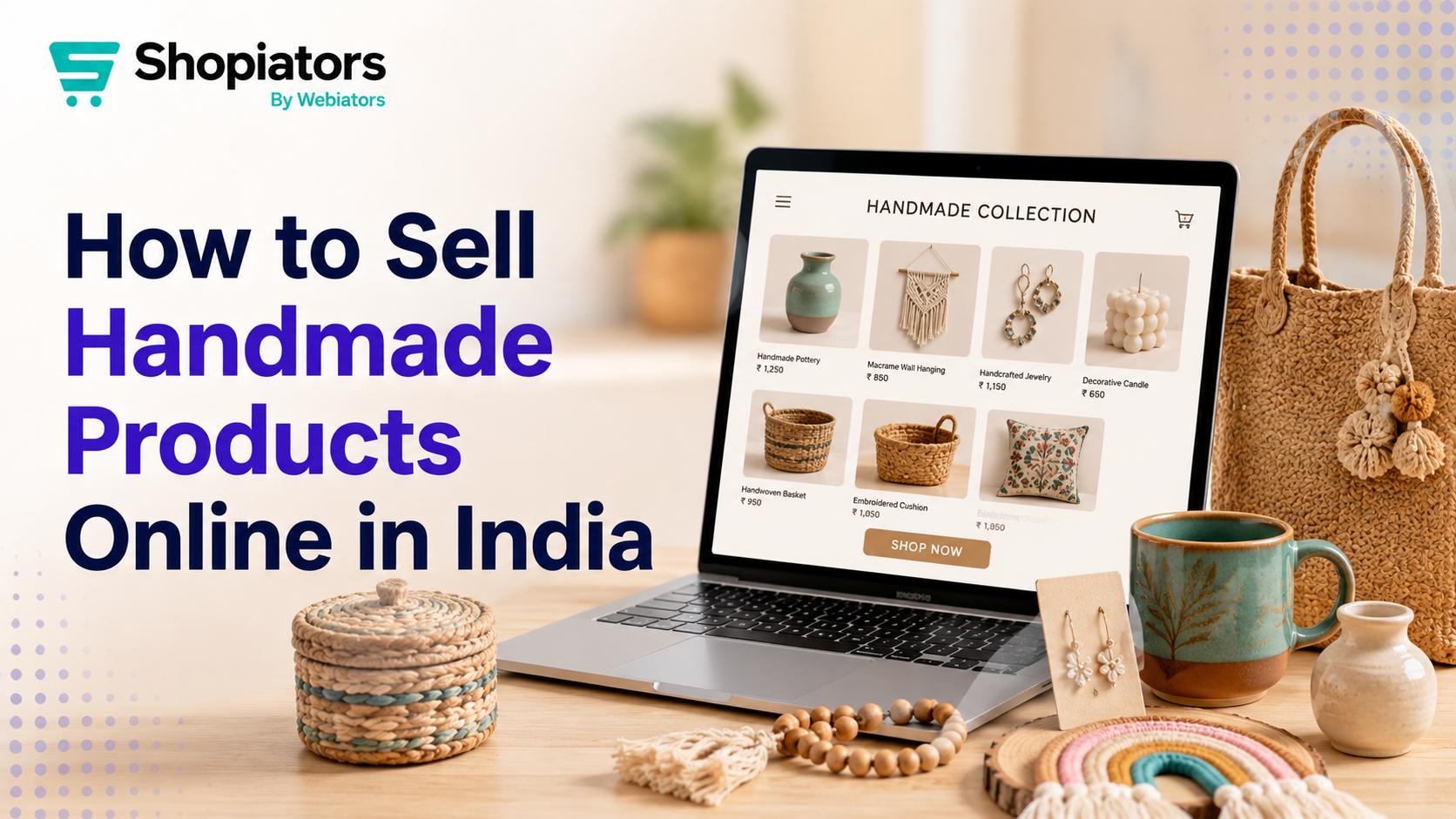
A handmade product can take hours to create, yet it can take only a few seconds for a customer to decide whether to buy it.
That is the challenge of selling handmade products online in India.
Your craftsmanship may be excellent, but customers cannot hold the product, inspect its finish, or speak to you across a screen. Your website, photos, pricing, descriptions, checkout, and delivery experience have to do that job.
If you are planning to sell candles, jewellery, pottery, textiles, home decor, paintings, customised gifts, or traditional crafts online, you do not need to build a huge ecommerce business overnight.
You need to build one that people can trust.
Start With One Strong Handmade Product Category
Do not begin by uploading everything you know how to make.
That sounds productive. It usually creates a messy store.
Start with a focused range. For example, you could sell handmade jewellery, scented candles, embroidered products, personalised gifts, or sustainable home decor.
The category should have a clear buyer and a clear reason to purchase.
Ask yourself:
Who is buying this, and why now?
A customer might need a personalized wedding gift. Another might be searching for Diwali decor. Someone else may want a handmade piece for their home.
These buying occasions matter because they help you decide what products to create, how to describe them, and where to promote them.
Your craft is the starting point.
Customer demand builds the business.
Price Your Products Like a Business
One of the easiest ways to make a handmade business unprofitable is to price products based only on material costs.
Suppose you spend ₹300 on materials and sell the finished product for ₹500. It may look like a ₹200 profit.
Not necessarily.
You still have your time, packaging, shipping, payment costs, marketing, damaged products, returns, photography, and website expenses to consider.
A practical pricing calculation should include:
- Raw materials
- Your labour or artisan wages
- Packaging
- Payment and platform charges
- Shipping or fulfilment costs
- Marketing expenses
- Discounts and promotions
- Overheads
- Desired profit
Your time counts too.
If a product takes three hours to make, that work should not disappear from the price simply because you made it at home.
Build Your Own Online Store
Instagram can help people discover your products. Marketplaces can help you reach existing shoppers.
But neither should necessarily be the foundation of your entire business.
A dedicated ecommerce website gives you more control over your brand, customer journey, product catalogue, checkout, promotions, and customer relationships.
When comparing an Ecommerce Platform India solution, look beyond the design.
Check whether it offers:
- Mobile-friendly storefronts
- Indian payment methods
- Shipping integrations
- Inventory management
- Discount codes
- Product variants
- SEO controls
- Analytics
- Secure checkout
- Easy website customisation
You should be able to update your store without calling a developer every time you want to change a product description.
That flexibility becomes important as your business grows.
Your Product Photos Need to Show the Craftsmanship
Online shoppers cannot pick up your product.
Your photos have to get as close as possible to that experience.
Use several photographs instead of one attractive hero image. Show the product from different angles. Include close-ups of texture, stitching, carving, finishing, or other details that make the item genuinely handmade.
Show scale too.
A customer should not have to guess whether a vase fits on a bedside table or whether a necklace pendant is delicate or oversized.
Lifestyle photos can also help. Show how the product looks in an actual home, gift setting, outfit, or workspace.
For handmade products, the making process itself can be valuable content.
A photograph of an artisan working on the product can communicate something that polished advertising often cannot: this item was actually made by someone.
Write Product Descriptions That Remove Doubts
“Beautiful handmade decor for your home” tells the customer almost nothing.
A useful description answers the questions they are likely to ask before purchasing.
Include details such as:
- Material
- Dimensions
- Weight
- Colour
- Finish
- Care instructions
- Personalisation options
- Processing time
- Packaging
- Delivery timeline
- Return or replacement conditions
Also explain natural variations.
Handmade products may have small differences in colour, texture, grain, shape, or finish. That is not necessarily a defect. Tell customers what to expect before they place an order.
Clear expectations prevent avoidable complaints.
Make Payments Easy for Indian Customers
A customer should never have to work hard to give you money.
Your ecommerce store should support payment methods familiar to your target buyers, such as UPI, cards, and net banking. Depending on your products and customer base, you may also consider cash on delivery.
Keep checkout straightforward.
Avoid unnecessary form fields. Make shipping charges visible. Show the expected delivery timeline. Give customers confidence that their payment is being processed securely.
A complicated checkout can undo excellent product marketing in seconds.
Take Shipping Seriously
Handmade products often need more careful packaging than mass-produced goods.
A ceramic planter, handmade candle, fabric accessory, and delicate jewellery piece cannot be packed in the same way.
Test your packaging before you start scaling orders.
Send a parcel to yourself.
Drop it. Turn it around. Leave it in transit for a while. Open it and inspect the product.
That little experiment can reveal weak boxes, loose inserts, poor cushioning, or moisture problems before a customer finds them for you.
Also separate processing time from delivery time.
If you need four days to make a customised product and another three to five days for delivery, say so clearly. Customers are much more likely to accept a longer timeline when they know what they are paying for.
Use Social Media to Tell the Story
Handmade products have a natural advantage here.
There is something to show.
Post the making process. Show packaging. Introduce the person behind the brand. Share customer photographs. Explain how a particular design was created. Create short videos around customisation, new collections, gifting occasions, and seasonal launches.
Do not make every post a sales pitch.
A customer may follow you because they like watching pottery being shaped or jewellery being assembled. Over time, that interest can turn into familiarity, and familiarity can turn into a purchase.
Your website closes the sale.
Your content can create the reason to visit it.
Start Small and Measure What Actually Sells
You do not need 50 products on launch day.
A smaller collection is easier to photograph, price, promote, stock, and improve.
Once your store starts receiving visitors, pay attention to what happens.
Look at:
| Metric | What it tells you |
| Product views | Which products attract attention |
| Conversion rate | Which products actually sell |
| Average order value | How much customers spend |
| Cart abandonment | Where buyers may be dropping off |
| Repeat purchases | Whether customers come back |
| Traffic sources | Where your buyers discover you |
Suppose one ₹899 handmade product gets more sales than five other products combined.
Do not simply celebrate it.
Study it.
Maybe the photographs are stronger. Perhaps the product solves a clearer problem. It might be easier to gift, better priced, or simply more appealing to your audience.
Those insights should influence your next product launch.
Which Ecommerce Platform Should You Choose?
If you are comparing Shopify with other options, look beyond the monthly subscription.
Compare the features that affect your actual business:
- Ease of store management
- Design flexibility
- Indian payment support
- Shipping integrations
- Transaction costs
- SEO capabilities
- Inventory tools
- Scalability
- Technical maintenance
This is where researching Shopify Alternatives India can be worthwhile. The right platform depends on how much control you want, how quickly you want to launch, and how much technical work you are prepared to handle.
A Best Ecommerce Website Builder should make the business easier to operate, not turn you into a part-time website administrator.
For sellers who want faster setup, an AI Ecommerce Website Builder can also reduce some of the repetitive work involved in creating pages, organising products, and getting a storefront ready.
Technology should stay in the background.
Your products should remain the star.
Turn a Handmade Product Into a Real Brand
Selling handmade products online in India is not simply about putting crafts on a website.
It is about creating enough trust for a stranger to purchase something they cannot physically examine.
That trust comes from good photographs.
Clear descriptions help.
Transparent pricing matters.
Reliable delivery matters even more.
And your brand story gives customers a reason to remember you.
You can start with five products and a simple storefront. You can learn from your first 20 customers instead of trying to predict everything before launch.
If you are still figuring out the basics, start with How to Start Online Store resources, choose an ecommerce platform that fits your business, and build from there.
Your handmade business does not need to look enormous on day one.
It needs to feel genuine, reliable, and worth buying from.
That is how a craft becomes a brand.
Read Also: How AI is Changing Ecommerce in India
Frequently Asked Questions
- What handmade products sell well online in India?
Handmade jewellery, candles, personalised gifts, pottery, home decor, textiles, and traditional crafts are popular choices.
- Where can I sell handmade products online in India?
You can sell through your own ecommerce website, marketplaces, social media, or a combination of these channels.
- How much does it cost to start selling handmade products online?
Costs vary based on inventory, packaging, website setup, shipping, payment fees, and marketing. You can start small and scale gradually.
- Do I need a website to sell handmade products?
No, but an ecommerce website gives you greater control over your branding, products, checkout, and customer experience.
- How can I get more customers for handmade products?
Use strong product photos, social media content, customer reviews, seasonal offers, and videos showing how your products are made.

Yogesh
Yogesh Khasturi is the Founder of Webiators Technologies and Shopiators. With 10+ years of experience in ecommerce, Shopify, Magento, SEO, CRO, and AI-powered commerce solutions, he has helped businesses worldwide build, optimize, and scale successful online stores. He regularly shares practical insights on ecommerce growth, AI search optimization (GEO), digital commerce trends, and online business strategy.