
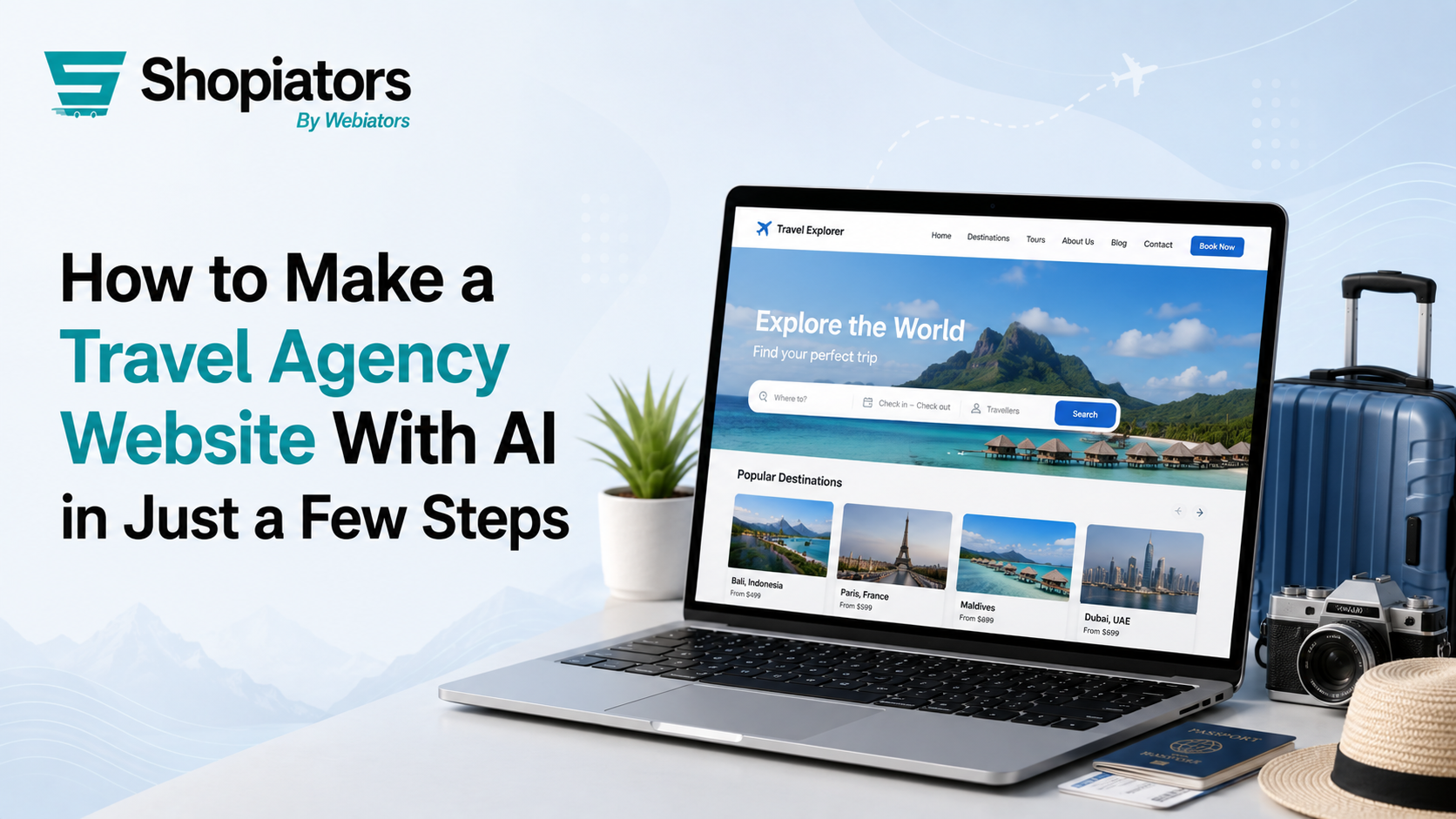
You do not need to start with a blank screen to build a travel agency website anymore.
With an AI-powered ecommerce website builder, you can generate the initial design, page structure, and storefront much faster, then customize it around your destinations, packages, booking process, and brand.
The important part is knowing what to build.
A travel website is not simply a digital brochure. It needs to help someone discover a destination, understand a package, trust your agency, and take the next step toward booking.
Here is the process I would use.
1. Define what your travel agency sells
Start with the business, not the website.
Decide what you want visitors to buy or inquire about.
For example:
- Bali vacation packages
- Honeymoon trips
- Family vacations
- Adventure tours
- International holiday packages
- Weekend getaways
- Custom itineraries
- Corporate travel services
A focused offer makes the AI-generated website much more useful.
Instead of asking AI to “create a travel website,” give it a specific brief:
Create a modern travel agency website for couples looking for customized honeymoon trips to Bali, Maldives, and Dubai. Include destination pages, travel packages, customer reviews, FAQs, inquiry forms, online payments, and a clear booking CTA.
That gives the builder enough context to create a relevant starting point.
2. Generate the website with AI
Now choose an AI website or ecommerce builder that lets you create and edit the storefront without rebuilding everything from scratch.
The AI can help establish your:
- Homepage
- Navigation
- Product or package sections
- About page
- Contact page
- FAQ section
- Collection pages
- Basic visual direction
This is where AI saves considerable setup time.
You still need to review every generated element. A travel business has specific requirements that generic AI cannot automatically understand.
Your cancellation policy, package inclusions, pricing, destination information, and booking rules should come from your business, not from an AI guess.
3. Turn travel packages into ecommerce products
This is the part many travel websites get wrong.
If your platform works like a modern ecommerce system, you can structure travel offers much like physical products.
For example:
Collection: Bali Tours
Product: 5-Day Bali Honeymoon Package
Variants: Standard, Premium, Luxury
Add-ons: Airport transfer, private tour, room upgrade
CTA: Book Now or Customize Trip
That structure makes packages easier to browse, manage, promote, and update.
It also gives you room to add upsells later.
A traveler booking a vacation may also need airport transfers, activities, insurance, hotel upgrades, or private transportation. Your website should make those options easy to understand rather than forcing customers to ask about every detail.
4. Create destination pages that answer real questions
Beautiful photographs attract attention.
Useful information earns the booking.
For every important destination, explain what travelers actually want to know.
Include:
- Best time to visit
- Recommended trip duration
- Popular experiences
- Package options
- Approximate starting prices, where appropriate
- What’s included
- What’s not included
- Travel requirements
- Frequently asked questions
- Booking or inquiry options
Don’t fill these pages with generic descriptions copied from elsewhere.
Add your own expertise.
If your agency specializes in family trips to Dubai, explain which areas work well for families, what activities are worth prioritizing, and how you typically structure the itinerary.
That is the information competitors cannot easily copy.
5. Add booking, inquiry, and payment options
Not every travel agency needs the same checkout process.
If you sell fixed packages, direct ecommerce checkout can work well.
If every itinerary is customized, a quotation or inquiry flow may make more sense.
You could ask for:
Destination → Travel dates → Number of travelers → Budget → Preferences → Contact details
Then your team can prepare the trip.
For fixed packages, you can simplify the journey:
View package → Select option → Add extras → Checkout → Confirmation
The goal is not to force every travel business into one model.
The goal is to make buying or inquiring feel obvious.
6. Make the website trustworthy before asking for money
Travel purchases carry emotion.
Someone may be spending thousands of dollars on a trip they have been planning for months. A vague website will make them hesitate.
Add genuine trust signals throughout the customer journey.
Useful examples include:
- Real customer reviews
- Authentic travel photographs
- Clear business information
- Contact details
- Secure payment options
- Cancellation and refund policies
- Team information
- Destination expertise
- Industry memberships or credentials, when applicable
Never invent reviews or credentials.
A smaller collection of authentic proof is far more convincing than a page filled with suspiciously perfect testimonials.
7. Optimize the travel website for mobile
Your customer may discover a destination on their phone, send the package to their partner, and return later from a laptop.
Your website needs to work across that entire journey.
Keep the important actions visible:
Explore Packages
Customize My Trip
Request a Quote
Book Now
Talk to an Expert
Also check image sizes and loading performance. Travel websites naturally rely on photography, but huge images can quickly make a mobile experience frustrating.
A fast website with slightly fewer images will usually serve the customer better than a beautiful website that takes forever to load.
8. Build SEO into the website from the beginning
Don’t wait until launch to think about search.
Create pages around the destinations, services, and questions your customers actually search for.
For example:
- Bali honeymoon packages
- Family vacation packages
- Best time to visit Dubai
- Customized Europe tours
- Affordable Maldives packages
- How to plan a Japan vacation
Each page should have a clear purpose.
Use descriptive URLs, useful headings, original content, relevant internal links, optimized images, and concise metadata.
The same principle helps with AI search.
ChatGPT, Gemini, Claude, Perplexity, and other answer engines need clear information they can understand and retrieve. Well-structured destination pages, FAQs, policies, and service information give them stronger context about your business.
AI Website Builder vs Traditional Website Development
You may be wondering whether an AI builder is actually worth using.
For many travel businesses, the answer depends on how much customization they need.
| AI-assisted website | Traditional development |
| Faster initial setup | Longer development cycle |
| AI-generated starting structure | Pages built manually |
| Easier for non-developers | Often more developer dependent |
| Commerce features can be integrated | Features may require separate development |
| Easy to iterate | Changes may take more time |
An AI Ecommerce Website Builder is particularly useful when you want to launch quickly but still need ecommerce functionality for packages, payments, customer accounts, promotions, and order management.
If you are comparing different platforms, evaluate them based on more than templates. Look at checkout flexibility, payment support, integrations, SEO controls, hosting, security, analytics, and scalability. That’s what separates a genuinely useful Best Ecommerce Website Builder from a pretty page editor.
What should a travel agency website include?
At minimum, I would launch with:
- Homepage
- Destination pages
- Travel package pages
- About page
- Contact page
- FAQs
- Reviews or testimonials
- Booking or inquiry flow
- Payment options
- Privacy, refund, and cancellation information
You can expand later.
You don’t need to build the entire internet on day one.
Build the website quickly. Improve it intelligently.
AI has removed much of the friction from starting a travel website.
You can generate the foundation faster, organize packages like products, publish destination content, connect commerce features, and start collecting inquiries without waiting for a long development cycle.
But AI should handle the repetitive work, not your business judgment.
Your destination knowledge, pricing strategy, customer service, policies, photography, reviews, and booking experience are what make the website credible.
Start with the AI-generated foundation.
Then make it unmistakably yours.
Ready to build your travel agency website? Create your store, add your travel packages, and turn your website into a real booking and sales channel.
Read Also: Step by step guide 2026: How to create your website within 10 minutes
FAQs
Can I make a travel agency website without coding?
Yes. AI-powered ecommerce builders can generate the initial website and let you edit pages, products, content, and design without writing code.
Can AI create a travel booking website?
AI can help create the website structure and content, but booking logic, payment settings, availability, policies, and integrations still need proper configuration and testing.
Can I sell travel packages through an ecommerce website?
Yes. Fixed travel packages can be presented as ecommerce products with variations, add-ons, pricing, and checkout. Custom trips may work better with an inquiry or quotation workflow.
What pages does a travel agency website need?
Start with your homepage, destinations, packages, About, Contact, FAQs, trust information, and booking or inquiry pages. Add supporting content as your business grows.
Is an ecommerce platform suitable for a travel agency?
It can be, especially when you sell predefined packages or add-on services. Businesses operating in India should also evaluate local payment, tax, and commerce requirements when choosing an Ecommerce Platform India solution.

Yogesh
Yogesh Khasturi is the Founder of Webiators Technologies and Shopiators. With 10+ years of experience in ecommerce, Shopify, Magento, SEO, CRO, and AI-powered commerce solutions, he has helped businesses worldwide build, optimize, and scale successful online stores. He regularly shares practical insights on ecommerce growth, AI search optimization (GEO), digital commerce trends, and online business strategy.