
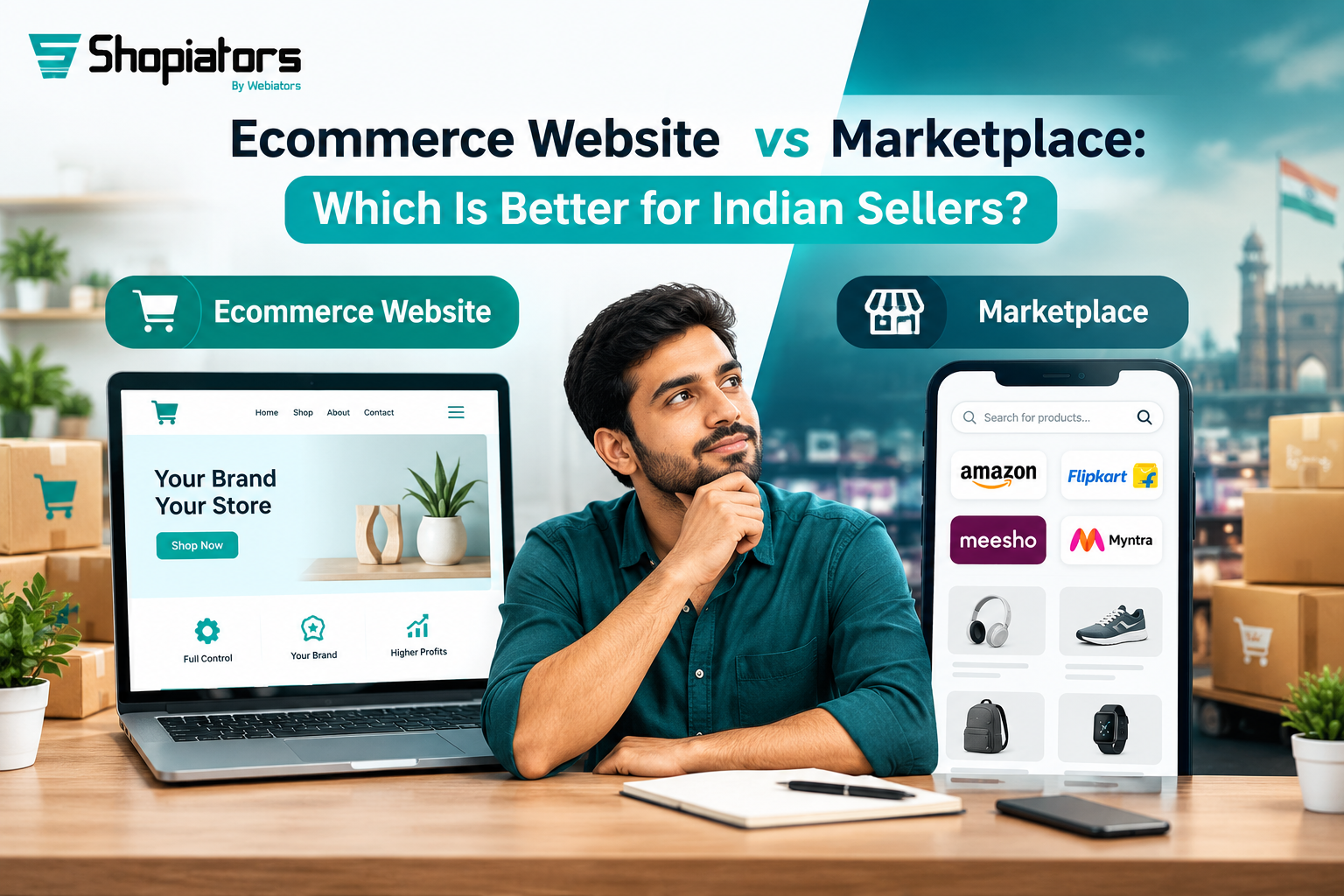
Ecommerce Website vs Marketplace: Which Is Better for Indian Sellers?
You can have a product people want and still struggle to build a brand around it.
A marketplace can put your products in front of ready-to-buy shoppers. That sounds great, and often it is. But your listing sits beside competing products, your visibility depends on platform rules, and the customer experience largely happens inside someone else’s ecosystem.
An ecommerce website gives you more control.
That is the real issue behind ecommerce website vs marketplace. One can help you get discovered faster. The other gives you a storefront you can shape around your brand.
For an Indian seller, the better choice depends on where the business stands today and where you want it to go.
Marketplace or ecommerce website: What do you actually control?
I often find it easier to explain this with a simple example.
Think of a marketplace as renting a shop inside a busy shopping complex. People are already walking past. You benefit from that footfall, but you still have to follow the complex’s rules.
That can be a big advantage when you’re starting out.
You can test products, reach existing shoppers and learn how online selling works without building every part of the sales channel yourself.
Your own website is different.
It is your shopfront. You decide how the homepage looks, which products get attention, what offers customers see and how the buying journey feels.
That control starts to matter a lot more once people begin recognising your brand.
Marketplace vs own website: The practical difference
| Factor | Marketplace | Own Ecommerce Website |
| Existing customer traffic | Strong advantage | You build traffic |
| Brand control | Limited | High |
| Store design | Platform restrictions | Flexible |
| Competition beside products | Common | You control the storefront |
| Customer experience | Platform-led | Brand-led |
| Marketing flexibility | Subject to platform rules | Greater control |
| Repeat-purchase strategy | Platform dependent | More direct control |
| Long-term brand building | Limited | Stronger opportunity |
Neither option is automatically better.
Your business stage matters.
When a marketplace makes sense
Say you manufacture cotton kurtis in Surat and have 20 designs ready to sell.
Would you build a complete ecommerce operation before knowing which designs customers actually like?
Probably not.
A marketplace can help you test the waters without taking on everything at once.
It can be useful when you are:
- Testing product demand
- Starting with limited marketing resources
- Looking for faster product discovery
- Learning how online orders and returns work
- Testing new products or categories
There is absolutely nothing wrong with starting there.
The bigger concern is relying on that channel forever while your brand keeps growing.
When your own ecommerce website starts making more sense
Now suppose those kurtis are selling consistently.
You have repeat buyers. You launch festive collections. Instagram is bringing enquiries. Customers are asking about bundles, colours and new arrivals.
Your needs have changed.
You need a storefront that sells the brand, not just the product.
With your own ecommerce website, you can create collection pages, build campaign landing pages, showcase bundles, publish useful content and give customers a clearer path from Instagram or WhatsApp to checkout.
And you don’t necessarily need a developer hovering over every small update.
An AI Ecommerce Website Builder can reduce much of the technical work involved in getting a store online and keeping it updated.
Of course, a tool cannot fix a poor product photo or an overpriced product.
Those jobs are still yours.
The right platform simply makes the work easier to manage.
Don’t judge platforms only by the monthly price
This is where many sellers get stuck.
They compare a marketplace’s fees with the subscription price of a website and decide based on the smaller number.
I wouldn’t.
Look at what you are actually getting.
Check:
- Payment and transaction costs
- Shipping and fulfilment options
- Store customisation
- SEO capabilities
- Product and inventory management
- Marketing integrations
- Analytics
- Customer support
- How easily your team can manage the store
If you’re researching Shopify Alternatives India, this becomes even more important. A cheaper platform is not much of a bargain if it leaves you paying for extra tools or struggling with features you need later.
At the same time, paying for dozens of features your business will never use is hardly sensible.
Choose for your business, not someone else’s feature checklist.
Indian ecommerce is becoming more multi-channel
There is another reason this decision is changing.
Indian sellers now have more ways to reach customers than simply choosing between one marketplace and one website.
ONDC is one example. A Government of India update reported more than 1.16 lakh retail sellers across over 630 cities and towns on the network as of December 2025. Another government update in June 2026 reported more than 5 lakh sellers, presence across 1,000 cities and nearly 90 lakh monthly transactions.
The point isn’t that every seller needs to join another channel.
It is that you have choices.
Your marketplace account, website, Instagram, WhatsApp and other channels can each do a different job.
Why using both can work surprisingly well
A marketplace can help you get discovered.
Your website can help you build the relationship.
A customer might discover your product on a marketplace, receive a nicely branded package, follow you on Instagram and eventually visit your website for the next purchase.
The journey could look like this:
Marketplace discovery → first purchase → brand experience → website visit → repeat purchase
Simple.
Each channel has a purpose.
For businesses comparing an Ecommerce Platform India option, that is worth keeping in mind. Your platform should make everyday tasks manageable while giving you enough room to expand as sales increase.
So, which is better for Indian sellers?
If your immediate priority is reaching shoppers who are already searching, a marketplace can be a sensible starting point.
If you want to build a recognisable brand, control the customer journey and encourage repeat purchases, your own ecommerce website becomes much more valuable.
For many Indian sellers, the strongest answer isn’t marketplace versus website.
It’s marketplace plus website.
Use the marketplace to find new customers.
Use your website to give those customers a reason to come back.
And as your business grows, let your own storefront become a bigger part of the business.
Because you’re not just trying to win today’s sale.
You’re building something customers can return to tomorrow.
Read Also: How to Build a Brand After Selling on Marketplaces
FAQs
- Is an ecommerce website better than a marketplace?
Not always. Marketplaces can provide quicker access to existing shoppers, while an ecommerce website gives you more control over branding, customer experience and your sales channel.
- Should a new Indian seller start with a marketplace or website?
A marketplace can be useful for testing demand and gaining initial exposure. A website makes sense early if building a long-term brand and repeat customer base is important to you.
- Can I sell through a marketplace and my own website?
Yes. You can use marketplaces to reach new shoppers while developing your own website as a direct sales channel.
- Is building an ecommerce website difficult for small businesses?
It doesn’t have to be. Modern ecommerce platforms and AI-powered builders can reduce technical work and make everyday store management simpler.
- Do I need Shopify to build an ecommerce website?
No. Shopify is one option among several. Compare pricing, payment options, features, customisation, integrations, SEO and support before deciding what fits your business.

Yogesh
Yogesh Khasturi is the Founder of Webiators Technologies and Shopiators. With 10+ years of experience in ecommerce, Shopify, Magento, SEO, CRO, and AI-powered commerce solutions, he has helped businesses worldwide build, optimize, and scale successful online stores. He regularly shares practical insights on ecommerce growth, AI search optimization (GEO), digital commerce trends, and online business strategy.