
A website can be launched in a day.
A brand cannot.
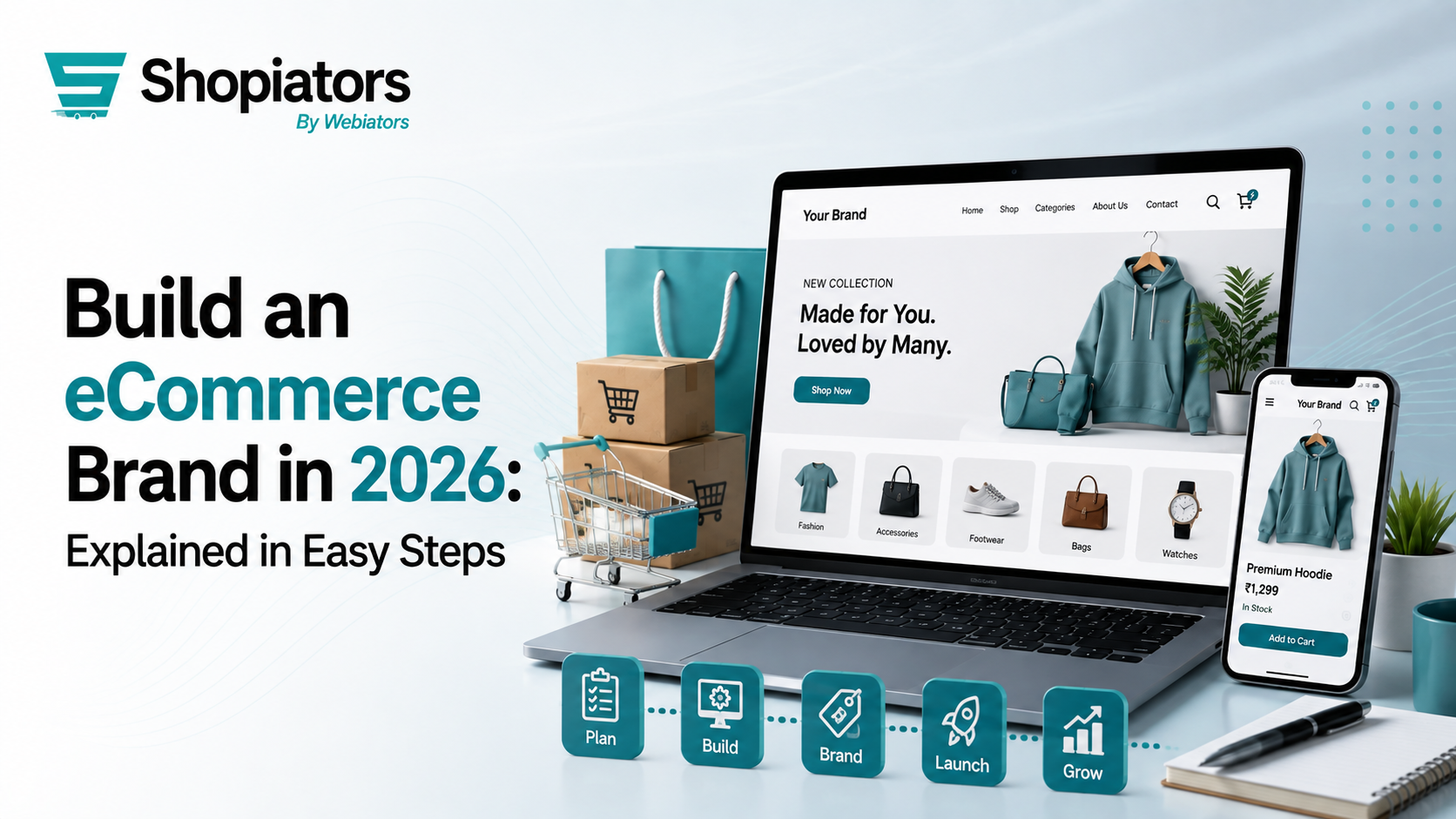
That difference matters when you build ecommerce website in India in 2026. You are not simply putting products online anymore. You are building a digital storefront that has to attract search traffic, earn trust, handle payments, convert mobile shoppers, and increasingly make your products understandable to AI-powered shopping tools.
India’s ecommerce market is expected to reach about $163 billion in 2026, according to IBEF.
The opportunity is huge.
So is the competition.
Here is how I would approach building an ecommerce brand today.
1. Start with the customer, not the website
The first mistake is opening an ecommerce platform before deciding what the business actually stands for.
Start with three questions:
- Who am I selling to?
- What problem does my product solve?
- Why should someone buy from me instead of another brand?
You don’t need a complicated brand strategy document.
You need clarity.
For example, “We sell skincare products” is a category.
“We make simple skincare for busy professionals who want a short, practical routine” is a positioning statement.
That second version gives you direction for your product selection, photography, copy, content, offers, and even your homepage.
Your website should make that promise obvious within seconds.
2. Choose an ecommerce platform for the business you want
The cheapest platform is not automatically the best choice.
Neither is the platform with the longest feature list.
When comparing an Ecommerce Platform India businesses can use, I recommend looking beyond the launch stage. Ask what happens when your catalog grows, orders increase, marketing becomes more sophisticated, and multiple people need access to the store.
At minimum, look for:
- Flexible storefront design
- Product and inventory management
- Secure checkout
- Indian payment options
- Shipping integrations
- SEO controls
- Analytics
- Marketing integrations
- App or API support
- Mobile-friendly shopping
- Room for customization
This is also where Shopify-style commerce platforms have changed merchant expectations. Store creation, product management, analytics, search, marketing, AI assistance, and selling capabilities increasingly sit inside one connected ecosystem.
If you’re researching Shopify Alternatives India, compare the actual business experience rather than just monthly subscription prices.
A platform that saves money but creates technical headaches later can become expensive very quickly.
3. Build the storefront around buying questions
Your homepage is not supposed to win a design award.
It has one job first: help the right visitor understand what you sell and where to go next.
A strong ecommerce store answers basic questions quickly:
What are you selling?
Who is it for?
Why should I trust you?
What does it cost?
How does delivery work?
What happens if I change my mind?
Then your product page takes over.
Use clear images. Show the product from useful angles. Explain benefits before drowning the reader in specifications. Add sizing, ingredients, materials, compatibility, shipping details, returns, reviews, and FAQs where they matter.
This is especially important on mobile.
Nobody wants to pinch, zoom, scroll sideways, close pop-ups, and hunt for the Add to Cart button just to buy a $999 product.
Make buying boringly easy.
That’s a compliment.
4. Treat payments as part of the customer experience
Indian ecommerce has its own buying habits, and your checkout needs to respect them.
UPI has become deeply embedded in everyday digital payments. In July 2026, UPI processed 23.66 billion transactions worth about $31.38 billion, according to data reported from NPCI figures.
For an ecommerce business, that means payment flexibility is not a minor technical feature.
It is part of conversion.
Offer the payment methods that make sense for your audience. Keep checkout straightforward. Show important costs before the final step. Make delivery information easy to understand.
A customer who reaches checkout should not suddenly discover a surprise shipping charge or an unfamiliar payment flow.
Small friction creates abandoned carts.
5. Build product pages that search engines and AI can understand
This is becoming one of the biggest changes in ecommerce.
Your product page is no longer written only for a human shopper or Google’s crawler.
AI-powered shopping systems increasingly use product information to understand what products are available, who they suit, what they cost, and how they compare.
Shopify’s 2026 research notes that AI shopping systems rely on structured, complete product information when matching products with shopper requests.
That gives you a practical rule:
Don’t make your product information vague.
Instead of:
Premium everyday bag.
Write useful information about:
- Material
- Dimensions
- Capacity
- Color
- Use cases
- Compatibility
- Care instructions
- Price
- Availability
- Shipping
- Returns
A machine cannot recommend what it cannot understand.
Neither can a shopper.
6. Use an AI Ecommerce Website Builder for speed, not strategy
An AI Ecommerce Website Builder can reduce the amount of manual work involved in creating a store.
That is useful.
AI can help with layouts, product content, recommendations, customer support, search, analytics, and other ecommerce tasks. Current ecommerce platforms are already applying machine learning to product discovery, forecasting, fraud detection, recommendations, and customer service.
But there is a trap.
If you let AI make every decision, your store can become polished but forgettable.
Use AI to accelerate execution.
Keep human judgment behind the positioning, product selection, customer promise, creative direction, and final messaging.
Speed matters.
Differentiation matters more.
7. Make your brand discoverable beyond Google
Search behavior is changing.
People still use traditional search engines, but they are also asking AI assistants for product recommendations, comparisons, and buying advice.
Shopify reported in 2026 that AI-referred shoppers were converting at nearly 50% higher rates and showing 14% higher average order values than organic search traffic across its analyzed data.
That does not mean you should abandon SEO.
It means your SEO needs to become more useful.
Create category pages that answer real shopping needs. Write product descriptions with meaningful detail. Publish helpful buying guides. Answer customer questions. Build strong internal links. Keep product data accurate.
For example, don’t create an article simply targeting “best handbags.”
Answer a genuine question such as:
Which handbag size is best for a daily office commute?
That page can naturally connect to relevant products, categories, and buying guides.
You’re creating information that both people and intelligent search systems can use.
8. Choose the right setup for your stage
A creator selling 20 products does not need the same infrastructure as a D2C brand managing thousands of orders.
Your platform should match your current needs while leaving room for growth.
If you’re launching
Prioritize:
- Fast setup
- Easy product management
- Templates
- Payments
- Shipping
- Basic analytics
- SEO controls
If you’re growing
Look for:
- Better automation
- Advanced analytics
- Marketing integrations
- Inventory management
- Customer segmentation
- More customization
- App and API capabilities
If you’re scaling
You may need:
- Advanced integrations
- Custom workflows
- Stronger performance
- Omnichannel capabilities
- More sophisticated customer data
- Deeper analytics
- Developer flexibility
The Best Ecommerce Website Builder is the one that removes unnecessary complexity without putting a ceiling on the business.
9. Measure the store like a business
Traffic feels exciting.
Revenue pays the bills.
After launch, watch the numbers that explain what customers actually do.
Track:
- Conversion rate
- Add-to-cart rate
- Checkout completion
- Average order value
- Customer acquisition cost
- Repeat purchase rate
- Product-level performance
- Organic and AI-referred traffic
Then find the weakest point.
If people visit but don’t add products to their carts, your problem may be product positioning, pricing, trust, or merchandising.
If carts are healthy but purchases are low, investigate checkout, shipping, payment options, or unexpected costs.
Don’t redesign the entire website because one metric looks disappointing.
Find the leak first.
10. Build for the next version of ecommerce
The strongest ecommerce brands in 2026 are not simply building websites.
They are building commerce systems.
Your storefront needs to sell.
Your content needs to explain.
Your product data needs to be discoverable.
Your platform needs to handle operations.
Your analytics need to reveal what is working.
And your brand needs to give people a reason to remember you.
AI-powered commerce is making this even more important. Shopify announced expanded integrations across AI shopping channels in 2026, including commerce experiences connected with Google, Gemini, Microsoft Copilot, and ChatGPT.
That shift changes the question.
Don’t ask only:
“How quickly can I launch my ecommerce website?”
Ask:
“Can my store be understood, trusted, discovered, and purchased from wherever my customer starts shopping?”
That is a much better standard.
Build the brand, not just the store
Launching an ecommerce website is the easy milestone.
Building something people choose repeatedly is the real work.
Start with a clear customer and a sharp product promise. Choose a platform that handles the technical foundation without slowing the business down. Create product pages that answer real questions. Make checkout simple. Build content around genuine search intent. Keep your product data accurate enough for both people and AI systems to understand.
Then keep improving.
Your first version does not need to be perfect.
It needs to be useful, trustworthy, fast, and ready to learn from real customers.
That is how you turn an ecommerce website into an ecommerce brand.
Read Also: Why Every Small Business Should Consider an AI Website Builder
FAQs
- How do I build an ecommerce website in India?
Choose an ecommerce platform, define your products and target customer, create your storefront, add product and category pages, connect payments and shipping, and test the complete buying journey before launch. Build SEO, analytics, mobile usability, and scalability into the setup from the beginning.
- What should I look for in an ecommerce platform in India?
Look for easy store management, flexible design, secure checkout, Indian payment options, inventory and order management, SEO controls, analytics, integrations, and room to customize as your business grows. Pricing matters, but the platform’s total value matters more.
- Can I build an ecommerce website without coding?
Yes. Modern no-code ecommerce platforms let you create pages, add products, manage orders, configure payments, and customize your storefront without traditional development. AI-powered tools can also speed up tasks such as store creation and content preparation.
- How do I make my ecommerce website visible on Google?
Create a crawlable site structure, link category pages to products, optimize product information, and use relevant structured data. Google recommends sharing product information through product structured data and Google Merchant Center to improve how ecommerce products can appear across Google surfaces.
- What is the best Shopify alternative in India?
The best Shopify alternative depends on your budget, technical requirements, customization needs, payment setup, integrations, and growth plans. Compare the complete commerce experience, including storefront management, checkout, SEO, inventory, analytics, and scalability, rather than comparing subscription prices alone.

Yogesh
Yogesh Khasturi is the Founder of Webiators Technologies and Shopiators. With 10+ years of experience in ecommerce, Shopify, Magento, SEO, CRO, and AI-powered commerce solutions, he has helped businesses worldwide build, optimize, and scale successful online stores. He regularly shares practical insights on ecommerce growth, AI search optimization (GEO), digital commerce trends, and online business strategy.