
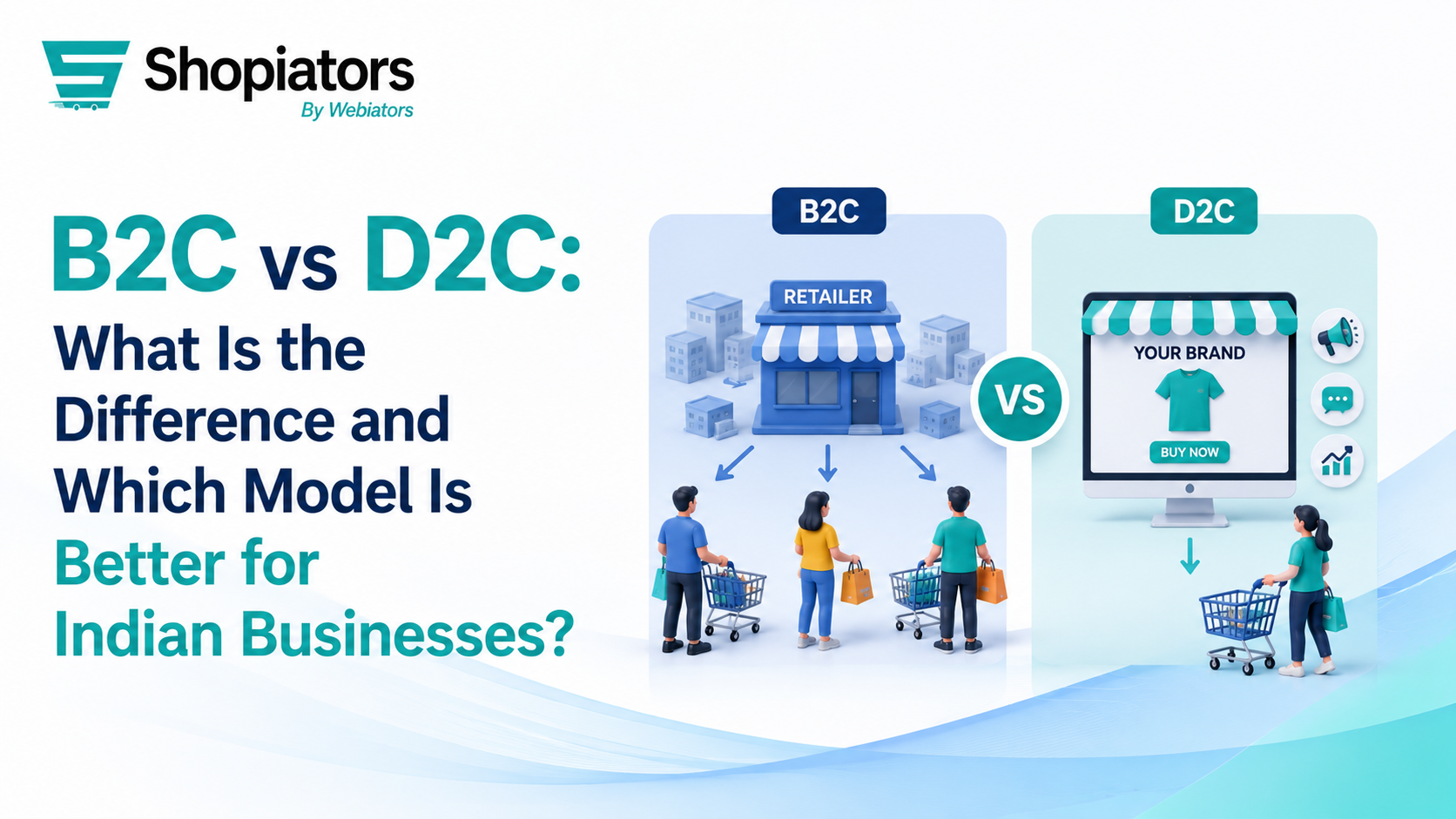
B2C vs D2C: What Is the Difference and Which Model Is Better for Indian Businesses?
India’s ecommerce market has evolved quickly. While marketplaces like Amazon and Flipkart continue to help businesses reach millions of shoppers, more brands are investing in their own online stores to build stronger customer relationships and reduce reliance on third-party platforms.
This has made many business owners ask an important question: What is the difference between B2C and D2C, and which model is better?
The answer isn’t choosing one over the other. D2C is actually a type of B2C business, and understanding how both models work can help you build a smarter ecommerce strategy.
What Is B2C?
B2C (Business-to-Consumer) refers to any business that sells products or services directly to individual consumers.
Businesses can sell through:
- Brand websites
- Online marketplaces
- Physical retail stores
- Mobile shopping apps
The focus is on who the customer is, not how the sale happens.
What Is D2C?
D2C (Direct-to-Consumer) is a B2C model where brands sell primarily through channels they own, such as their ecommerce website or mobile app, instead of relying on wholesalers, distributors, or marketplaces.
This gives brands greater control over customer interactions, branding, and the overall shopping experience.
Simply put: Every D2C business is B2C, but not every B2C business is D2C.
Difference Between B2C and D2C
| Feature | B2C | D2C |
| Business Model | Sells to consumers through various channels | Sells directly through owned channels |
| Sales Channels | Retailers, marketplaces, stores, or websites | Primarily brand-owned website or app |
| Customer Data | Depends on the sales channel | Brand owns first-party customer data |
| Brand Control | Shared with intermediaries in some cases | Greater control over customer experience |
| Costs | May include marketplace commissions | Lower intermediary costs but higher responsibility for marketing and operations |
The biggest difference between B2C and D2C isn’t the customer. It’s the level of control a business has over branding, customer relationships, and sales.
Which Model Is Better for Indian Businesses?
There’s no one-size-fits-all answer.
B2C works well if you want to:
- Reach customers quickly
- Leverage marketplace traffic
- Test new products with lower upfront marketing efforts
D2C is a better choice if you want to:
- Build a long-term brand
- Own customer relationships
- Collect first-party customer data
- Create personalized shopping experiences
Many successful Indian brands combine both approaches. They use marketplaces to attract new customers while encouraging repeat purchases through their own ecommerce websites. This hybrid strategy helps balance visibility with long-term brand growth.
Choosing the Right Ecommerce Platform
Whether you follow a B2C or D2C strategy, your ecommerce platform should support future growth.
If you’re exploring an AI Ecommerce Website Builder, look beyond speed and focus on features like SEO, mobile responsiveness, secure payments, analytics, and marketing automation.
Businesses comparing Shopify Alternatives India should evaluate scalability, customization, integrations, and pricing instead of choosing a platform based only on popularity.
When selecting an Ecommerce Platform India, consider local payment gateways, shipping integrations, GST support, and ease of management. If you’re still learning How to Start Online Store, begin with a platform that can grow alongside your business instead of requiring a costly migration later.
Final Thoughts
Understanding the difference between B2C and D2C helps you make better decisions about how you sell online.
B2C describes businesses that sell to consumers, while D2C is a strategy where brands sell directly through their own channels. Neither model is universally better. The right choice depends on your goals, budget, and growth plans.
For many Indian businesses, combining marketplace sales with a branded ecommerce store offers the best of both worlds. It increases visibility while giving you greater control over customer relationships, marketing, and long-term growth.
As your business scales, choosing the right ecommerce platform and sales strategy will have a lasting impact on customer experience and profitability.
Read Also: How AI Helps Small Businesses Sell Online
Frequently Asked Questions
- What is the difference between B2C and D2C?
B2C refers to any business selling products or services to consumers. D2C is a B2C approach where brands sell directly through their own channels rather than relying primarily on intermediaries.
- Is D2C better than B2C?
Not always. D2C offers greater control over branding and customer relationships, while traditional B2C channels like marketplaces provide wider reach. Many businesses successfully use both.
- Can a D2C brand sell on marketplaces?
Yes. Many D2C brands also sell through marketplaces to increase visibility while continuing to grow their own online stores.
- Why are Indian businesses adopting D2C?
D2C allows businesses to build direct customer relationships, collect first-party data, strengthen brand identity, and reduce dependence on third-party platforms.
- How do I choose the right ecommerce platform?
Look for a platform with strong SEO capabilities, secure payment integrations, inventory management, mobile optimization, analytics, and scalability to support long-term business growth

Yogesh
Yogesh Khasturi is the Founder of Webiators Technologies and Shopiators. With 10+ years of experience in ecommerce, Shopify, Magento, SEO, CRO, and AI-powered commerce solutions, he has helped businesses worldwide build, optimize, and scale successful online stores. He regularly shares practical insights on ecommerce growth, AI search optimization (GEO), digital commerce trends, and online business strategy.