
There’s a question I like asking marketplace sellers.
“If your best-selling product disappeared tomorrow, what would customers remember?”
Most people pause.
Not because they don’t know their business, but because the answer is uncomfortable.
The customer might remember the product. They might remember getting a good deal. They probably won’t remember your brand.
That’s the difference between selling online and building something that lasts.
A Meesho seller business can grow surprisingly fast. Meesho has removed many of the traditional barriers to ecommerce by offering free seller registration, zero commission across categories, integrated logistics, and a large customer base. According to the company’s latest public figures, the platform serves over 264 million annual transacting users and works with more than 961,000 annual transacting sellers. Those numbers explain why thousands of entrepreneurs choose Meesho as their starting point.
And honestly, that makes sense.
If I wanted to validate a product idea with limited investment, I’d seriously consider a marketplace too. It lets you learn what customers buy before spending money on your own website or marketing.
The mistake isn’t selling on Meesho.
The mistake is believing that marketplace success automatically turns into brand success.
It rarely does.
I’ve seen sellers celebrate crossing their first thousand orders, only to worry a few months later because sales suddenly slowed after new competitors entered with nearly identical products. Nothing changed about the product quality. The market simply became noisier.
That’s when an important realization hits.
Customers were buying from the marketplace, not necessarily from the seller.
A Marketplace Builds Sales. A Brand Builds Loyalty.
People often use the words business and brand as if they mean the same thing.
They don’t.
A business earns revenue.
A brand earns recognition, trust, and repeat customers.
That’s why two sellers can offer almost identical products yet end up with completely different futures. One keeps chasing the next trending item. The other builds a name that customers actively search for.
Here’s the difference.
| Selling on a Marketplace | Building a Brand |
| Focus is on generating orders | Focus is on creating loyal customers |
| Visibility depends on the platform | Visibility grows through your own marketing and reputation |
| Price often becomes the deciding factor | Trust becomes the deciding factor |
| Growth relies heavily on marketplace traffic | Growth comes from repeat buyers and brand recognition |
Neither model is wrong.
In fact, many successful D2C businesses continue selling on marketplaces long after launching their own stores.
The difference is that they don’t depend on marketplaces alone.
They use them as one acquisition channel while steadily investing in assets they actually own, such as their website, email list, customer community, and brand identity.
That’s where the conversation changes.
Instead of asking, “How do I get more orders next month?”
The question becomes:
“How do I make customers remember my business even when they’re no longer browsing a marketplace?”
That shift in thinking is exactly where brand building begins.
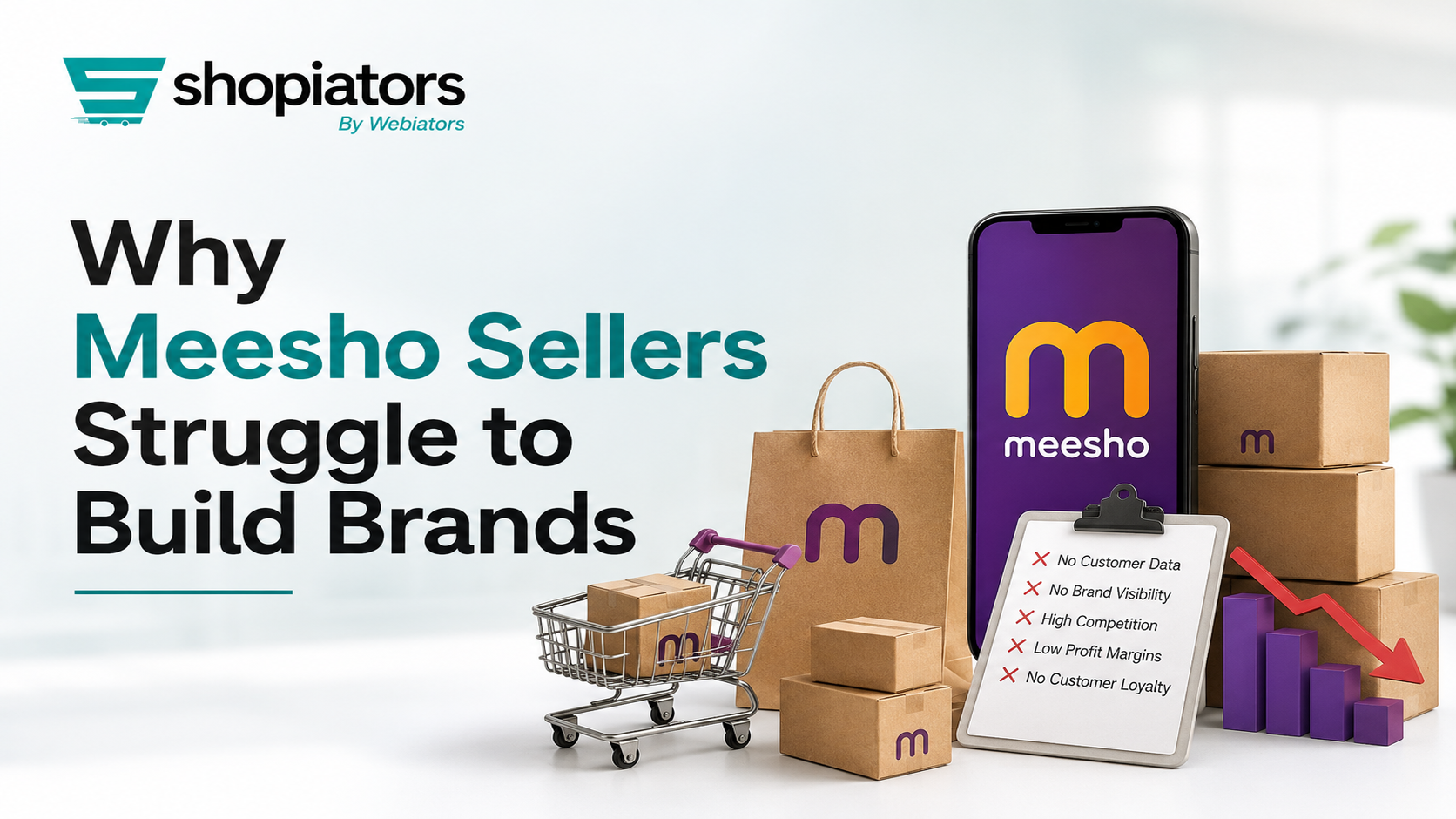
Why Meesho Sellers Struggle to Build Brands
Every marketplace promises reach.
Very few promise brand ownership.
That isn’t a flaw in Meesho. It’s simply how marketplaces are built. Their priority is to help customers discover products quickly, compare prices, and complete a purchase with minimal friction. Your priority, however, is different. You want customers to remember your business after the purchase is over.
Those goals don’t always move in the same direction.
Here are the biggest reasons many Meesho sellers find it difficult to build a recognizable brand.
1. Customers Buy the Product, Not the Seller
Think about your own online shopping habits.
When you order a phone cover or a kitchen organizer from a marketplace, do you remember the seller’s name a week later?
Most people don’t.
They remember the product they bought, not who sold it.
The same behavior applies to your customers. If your business exists only inside a marketplace, your brand often stays in the background while the marketplace remains front and center.
That makes it harder to earn direct searches, word-of-mouth referrals, and repeat purchases based on brand recognition.
2. Price Competition Never Really Stops
A product starts selling well.
Within weeks, similar listings begin appearing.
Some sellers reduce prices. Others offer discounts or bundle deals. Before long, everyone is competing for the same customer.
This isn’t unique to Meesho. It’s common across almost every online marketplace.
The challenge is that price becomes one of the easiest ways to stand out when customers don’t have a strong reason to choose one brand over another.
Businesses built only on low prices often find themselves caught in a cycle of shrinking margins and constant competition.
3. You Don’t Fully Control the Customer Experience
A memorable brand is built through dozens of small moments.
Your website design.
Your product story.
The emails customers receive.
The loyalty rewards they earn.
The way you introduce a new collection.
On a marketplace, many of those touchpoints are standardized because the platform is designed to provide a consistent shopping experience for every customer.
That’s great for convenience.
It’s less helpful when you’re trying to create a distinct identity that customers associate with your business.
4. Repeat Customers Are Harder to Nurture
One purchase is encouraging.
The second, third, and fourth purchases are where profitable brands are built.
Businesses with their own ecommerce store can create loyalty programs, publish helpful content, collect newsletter subscribers, and launch personalized campaigns to bring customers back.
Marketplace sellers have fewer opportunities to build those long-term relationships because the shopping journey is largely controlled by the platform.
That’s why many established businesses eventually invest in their own online store. It gives them more ways to stay connected with customers after the first sale.
5. Your Growth Depends on Someone Else’s Rules
Every online platform evolves.
Policies change.
Features improve.
Algorithms are updated.
None of those changes are inherently good or bad, but they remind us of an important business principle:
The more your growth depends on a platform you don’t control, the less control you have over your future.
Successful ecommerce businesses usually reduce that risk over time.
They continue selling through marketplaces because the reach is valuable, but they also build channels they own, including their website, customer database, social community, and content.
That’s where long-term stability comes from.
A marketplace can help you find customers.
A brand gives customers a reason to come back.
What Successful D2C Brands Do Differently
Here’s something I’ve noticed over the years.
The brands that grow consistently aren’t obsessed with where they sell. They’re obsessed with what they own.
They treat marketplaces as a growth channel, not as the entire business.
That shift changes everything.
Instead of relying on one platform for every sale, they gradually create an ecosystem that customers recognize and trust.
They Build Assets That Stay With Them
Imagine opening two shops.
One is inside a busy shopping mall. The other is on land you own.
The mall brings foot traffic, but the rules belong to the mall owner. Your own shop may take longer to attract visitors, but every improvement you make increases the value of your business.
The same principle applies to ecommerce.
A branded online store becomes an asset. Your content, customer relationships, email subscribers, product pages, and marketing efforts continue working for your business instead of strengthening someone else’s platform.
That’s one reason many growing brands eventually look for an Ecommerce Platform India that gives them more control over branding, customer experience, and future growth.
They Don’t Depend on One Source of Sales
Healthy ecommerce businesses spread their risk.
A common growth mix looks like this:
- Marketplace sales for discovery
- Own website for brand building
- Social media for community
- Email and WhatsApp for repeat purchases
- Search engines for long-term organic traffic
If one channel slows down, the business doesn’t stop moving.
That’s a much stronger position than depending on a single marketplace.
Marketplace First. Brand Always.
Here’s a simple comparison.
| Marketplace-Only Business | Brand-First Business |
| Chases the next trending product | Builds a recognizable identity |
| Depends mainly on marketplace traffic | Generates traffic from multiple channels |
| Competes heavily on pricing | Competes on trust, quality, and experience |
| Revenue rises and falls with platform visibility | Creates repeat customers through owned channels |
| Focuses on today’s sale | Focuses on customer lifetime value |
The point isn’t to leave Meesho.
The point is to stop expecting it to do everything.
Many successful sellers continue using marketplaces because they’re excellent for reaching new buyers. They simply don’t let the marketplace become the only place where their business exists.
So, When Should You Launch Your Own Store?
There’s no perfect revenue milestone.
Some sellers launch after 100 orders.
Others wait until they’ve crossed 10,000.
A better question is this:
Are people buying your products, or are they beginning to look for your brand?
If the answer is the second one, it’s probably time to think beyond marketplaces.
Building your own store gives you the freedom to shape the customer journey, strengthen your identity, and create a shopping experience that’s unmistakably yours.
If you’re evaluating the next step, exploring Shopify Alternatives India can help you compare platforms based on pricing, features, customization, and long-term scalability. And if you’re starting from scratch, understanding How to Start Online Store the right way can save you from expensive mistakes later.
The goal isn’t to replace marketplaces.
It’s to make sure your business can grow even without depending entirely on them.
From Marketplace Seller to Brand Builder
If there’s one takeaway I’d want every Meesho seller to remember, it’s this:
A marketplace can help you sell. It can’t build your brand for you.
That’s not a criticism of Meesho. It’s simply the role marketplaces play in ecommerce.
They bring customers, simplify operations, and reduce the barriers to starting an online business. For thousands of entrepreneurs, that’s exactly what makes them valuable.
But long-term brands are built differently.
They invest in trust before transactions. They create memorable experiences instead of relying only on product listings. Most importantly, they build channels they own, so their growth isn’t tied to a single platform.
If your products are already selling on Meesho, you’ve crossed one of the hardest milestones. You’ve proven that people are willing to buy what you offer.
Now ask yourself a different question.
What happens if those same customers want to buy from you again?
If your answer isn’t clear, that’s probably the next area your business should improve.
Building an independent store doesn’t mean walking away from marketplaces. Many successful brands continue selling on multiple platforms because it expands their reach. The difference is that they also give customers a destination where the brand takes center stage.
If you’re planning that next step, choosing the right Ecommerce Platform for Creators can make the transition much smoother. A platform built specifically for ecommerce gives you greater control over your storefront, customer experience, and future growth without forcing you to manage unnecessary technical complexity.
The strongest ecommerce businesses rarely rely on one sales channel.
They build a brand that customers remember, recommend, and return to.
That’s a business worth building.
Read Also: Cheapest Ecommerce Platform in India
FAQs
Is Meesho good for starting an ecommerce business?
Yes. Meesho is a good option for validating products and reaching customers with a low initial investment. Many entrepreneurs use it to test demand before expanding to their own online store.
Can I build a brand by selling only on Meesho?
You can build sales on Meesho, but creating long-term brand recognition is more challenging if your business relies only on a marketplace. Most established D2C brands combine marketplace selling with their own ecommerce website.
Should I leave Meesho after launching my own store?
Not necessarily. Many successful businesses continue selling on marketplaces while using their own website to strengthen branding, improve customer retention, and diversify revenue.
When should I create my own ecommerce website?
A good time is when your products have consistent demand, you’re receiving repeat customers, or you want greater control over branding, marketing, and customer relationships.
Why do successful D2C brands use multiple sales channels?
Multiple channels reduce dependency on a single platform and create more opportunities to acquire, engage, and retain customers over time.

Yogesh
Yogesh Khasturi is the Founder of Webiators Technologies and Shopiators. With 10+ years of experience in ecommerce, Shopify, Magento, SEO, CRO, and AI-powered commerce solutions, he has helped businesses worldwide build, optimize, and scale successful online stores. He regularly shares practical insights on ecommerce growth, AI search optimization (GEO), digital commerce trends, and online business strategy.