
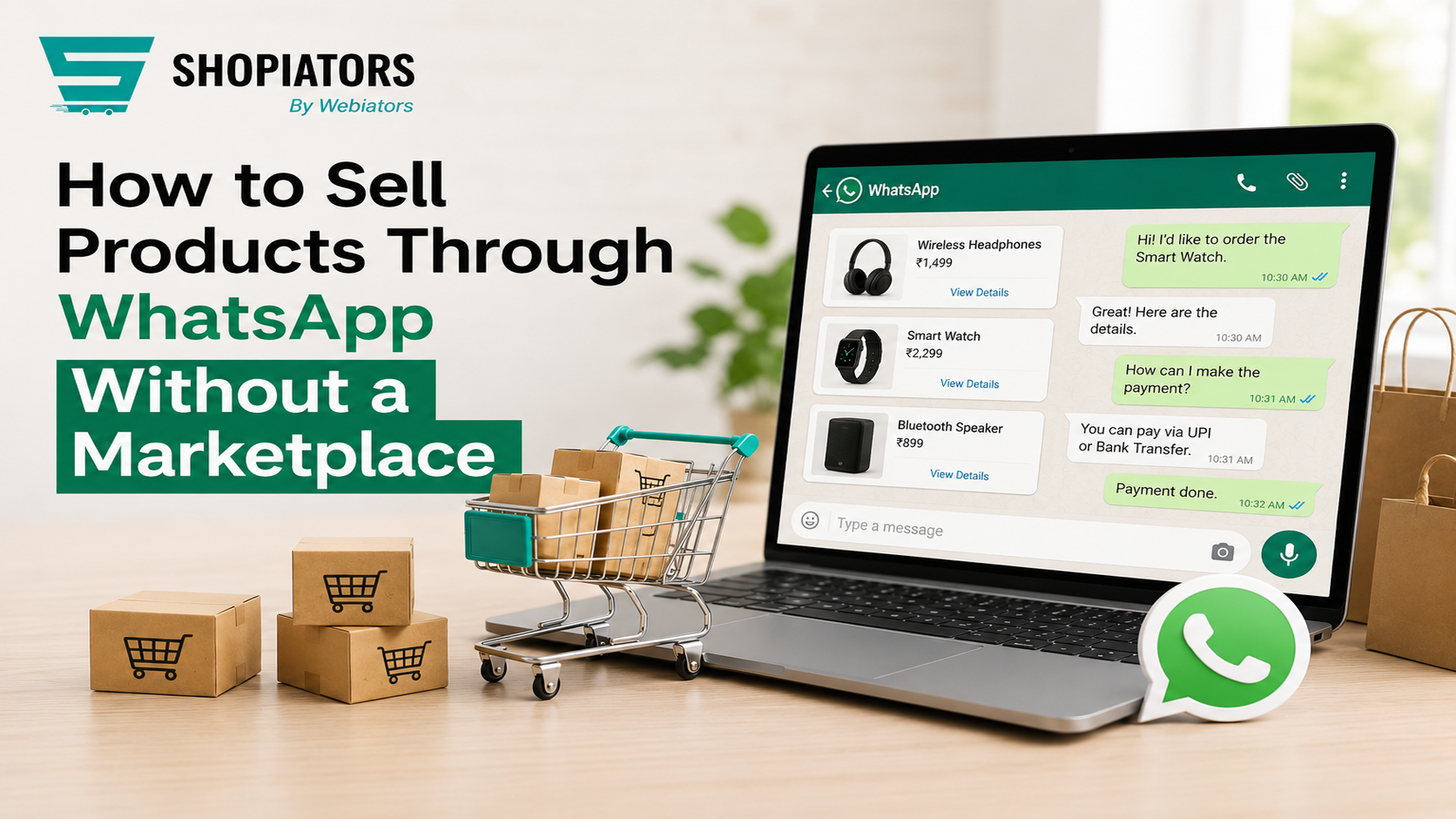
A customer sends one message:
“Price?”
You reply.
Then comes:
“Available in blue?”
Another reply.
“How much is shipping?”
Another.
“Can I pay by UPI?”
By the time you finish explaining everything, the customer has gone silent.
This is where many businesses misunderstand how to sell products on WhatsApp. The problem is not WhatsApp. The problem is making a messaging app carry the entire burden of ecommerce.
You can do better.
Use WhatsApp to start and support the conversation, while your own ecommerce website handles the product experience, checkout, payments, and order management.
That gives customers the convenience of messaging without forcing your business to depend on a marketplace.
Can You Sell Products on WhatsApp Without a Marketplace?
Yes.
You can use WhatsApp Business to showcase products, share catalogs and product links, answer questions, help customers choose products, and move buyers toward purchase. WhatsApp also supports shopping features such as catalogs and carts, although available commerce and payment features can vary by market and business.
The important distinction is this:
WhatsApp can be your sales channel without becoming your entire ecommerce infrastructure.
Your website remains the place where customers can explore your brand and complete purchases.
That is a much stronger long-term setup.
The Best WhatsApp Ecommerce Model Is a Two-Part System
Think of the customer journey as two connected rooms.
Room 1: WhatsApp
This is where customers ask questions, discover products, request recommendations, and get personal assistance.
Room 2: Your ecommerce store
This is where customers see detailed product information, select variants, complete checkout, pay, and receive order confirmation.
The journey becomes:
Social media / search → WhatsApp → Product page → Checkout → Payment → Order fulfillment
Clean.
Trackable.
Much easier to scale.
WhatsApp itself allows businesses to create catalogs containing product information such as images, descriptions, prices where supported, product codes, and website links.
That means you do not need to send five product photos and a price in separate messages every time someone asks what you sell.
What Should You Sell Through WhatsApp?
Not every product needs the same sales approach.
WhatsApp works particularly well when customers benefit from conversation before purchasing.
For example:
- Fashion and apparel
- Beauty and personal care
- Jewelry
- Customized products
- Home decor
- Gifts
- Food and specialty products
- D2C products requiring product guidance
- Products with sizing or variant questions
Consider a customer buying a kurta.
They might ask about size, fabric, color, delivery time, and return policy before purchasing.
That conversation has value.
But you should not make the customer depend on you for information that already belongs on the product page.
Answer the personal question in WhatsApp. Let your store answer the repetitive ones.
How to Sell Products on WhatsApp Step by Step
1. Create a proper ecommerce store
Start with your own storefront.
Your product pages should clearly show:
- Product name
- Price
- Images
- Variants
- Availability
- Key specifications
- Shipping information
- Returns and exchanges
- FAQs
- Clear checkout button
If your store is difficult to use on a phone, WhatsApp traffic will not magically fix it.
A good Best Ecommerce Website Builder should make mobile storefront creation, product management, checkout, payments, and everyday store operations straightforward.
2. Connect WhatsApp to your buying journey
Do not hide WhatsApp in the footer.
Use it where customers naturally need assistance.
For example:
Need help choosing a size? Chat with us on WhatsApp.
Or:
Have a question about delivery? Ask us on WhatsApp.
That creates a useful reason to start a conversation instead of simply shouting “Buy Now.”
3. Send product links, not product essays
Suppose a customer asks:
“Do you have the black one under $50?”
A weak response:
“Hi, yes we have black. It is $42. It comes in three sizes. Shipping is available…”
A better response:
“Yes, the black version is available at $42. You can check the sizes and delivery details here: [product link]. If you want, I can also help you choose the right size.”
The customer gets information and assistance.
That feels personal without creating unnecessary work.
Don’t Turn WhatsApp Into Your Order Spreadsheet
This is one of the easiest mistakes to make.
A customer sends:
Name: Priya
Product: Blue handbag
Quantity: 2
Address: …
Payment: Paid
Then another customer sends a slightly different format.
Then someone edits their address.
Then somebody asks whether the order shipped.
Suddenly your WhatsApp inbox has become an improvised order management system.
That is where things go wrong.
Use your ecommerce platform for structured order data.
Let the website capture customer details, calculate totals, process checkout, and create orders. WhatsApp can remain available for questions and support.
Your future self will thank you.
WhatsApp Can Also Help Recover Lost Sales
Here is an opportunity many store owners overlook.
A customer may ask about a product, visit your website, and leave without purchasing.
That conversation can reveal why.
Maybe the shipping cost was unclear.
Maybe the customer was unsure about sizing.
Maybe they wanted another payment option.
Maybe they simply needed reassurance.
These conversations are useful conversion data.
Instead of treating WhatsApp as another inbox, look for patterns:
| Customer question | Possible store problem |
| “When will it arrive?” | Delivery information is unclear |
| “Is this available?” | Inventory visibility needs improvement |
| “What size should I buy?” | Product sizing needs better guidance |
| “Can I return it?” | Return policy is hard to find |
| “How do I pay?” | Payment options need clearer presentation |
Your customers are practically telling you how to improve your website.
Listen.
What About WhatsApp Payments?
WhatsApp commerce capabilities are evolving.
Meta announced additional payment capabilities for eligible small businesses in India, including payment options within the WhatsApp Business experience. Meta has also announced Business AI features in India that can answer customer questions, recommend products, and support sales, with additional payment functionality being introduced over time. Availability can depend on eligibility and rollout.
So should your entire business move inside WhatsApp?
I would not recommend building your strategy around one channel.
Features change.
Policies change.
Customer behavior changes.
Your ecommerce website gives you a more stable foundation that you control.
WhatsApp then becomes a powerful layer on top of it.
WhatsApp + Your Website Beats Marketplace Dependence
A marketplace can provide reach.
It can also put your product beside dozens of competing products, limit how you present your brand, and make the customer relationship less direct.
With your own ecommerce store, you can build:
Brand → Product discovery → Customer relationship → Checkout → Repeat purchase
WhatsApp strengthens that relationship because customers can reach you conversationally.
This is especially useful for D2C brands that want to build repeat purchases rather than constantly chase new marketplace traffic.
Businesses comparing Shopify Alternatives India should therefore look beyond themes and pricing. Ask a more practical question:
Can this platform support the way I actually want customers to discover, trust, buy, and return?
That matters far more than choosing a platform simply because everyone else uses it.
A Smarter WhatsApp Sales Funnel
Here is a simple funnel you can implement:
Attract
Use Instagram, Facebook, Google, influencers, content, ads, QR codes, and your website to generate interest.
Start the conversation
Give customers a clear WhatsApp entry point when they need help.
Qualify
Understand what they want instead of immediately pushing a product.
Recommend
Send the most relevant product or collection.
Convert
Move the customer to a fast, mobile-friendly checkout.
Retain
Use permitted WhatsApp communication for support, updates, and relevant customer engagement.
That last stage matters.
The first order pays the bills.
Repeat customers can build the business.
Where AI Can Make WhatsApp Selling Easier
As order volume increases, answering every basic question manually becomes expensive.
AI can help with repetitive questions such as:
- Product availability
- Basic product information
- Shipping questions
- Store policies
- Product recommendations
- Common customer queries
Meta’s 2026 Business AI rollout for eligible Indian businesses specifically includes automated responses, product recommendations, lead capture, and sales assistance.
If you are building or upgrading your store, Shopiators, an AI Ecommerce Website Builder can also reduce the technical effort involved in creating and managing the storefront itself.
But automation should remove repetitive work, not remove the human part of selling.
If a customer has a complicated problem, give them a person.
The Real Goal Is Not More WhatsApp Messages
More messages do not automatically mean more sales.
Better conversations do.
A strong WhatsApp ecommerce strategy should help you answer three questions:
Where did the customer come from?
What stopped them from buying?
What finally convinced them?
Once you know those answers, WhatsApp becomes more than a messaging app.
It becomes a source of customer insight.
And your ecommerce website becomes the engine that turns that insight into revenue.
Build the Store. Keep the Conversation.
You do not have to choose between WhatsApp and your ecommerce website.
Use each for what it does best.
WhatsApp starts the conversation.
Your website makes buying easy.
Your backend keeps the operation organized.
Your customer data and insights help you improve.
That is a far more scalable approach than manually taking orders one WhatsApp message at a time.
And when a customer eventually sends that familiar “Price?”, you will have something better than a number ready.
You will have a complete buying journey.
Read Also: How to Create an Online Store for a Small Business in India
FAQs
Can I sell on WhatsApp without using Amazon or another marketplace?
Yes. You can use WhatsApp as a customer acquisition and sales channel while directing customers to your own ecommerce website for browsing and checkout.
Do I need an ecommerce website to sell on WhatsApp?
No, not technically. WhatsApp Business provides catalog and shopping capabilities. However, an ecommerce website gives you greater control over your storefront, checkout, SEO, analytics, customer experience, and long-term growth.
Can I add my product catalog to WhatsApp?
Yes. WhatsApp Business supports product catalogs, and businesses can include product information and website links. Catalogs can also be shared with customers.
Can customers pay through WhatsApp?
Payment availability depends on the country, business, and feature eligibility. Meta has introduced additional WhatsApp payment capabilities for eligible businesses in India, so businesses should check the current options available to their account.
Is WhatsApp better than a marketplace for ecommerce?
They serve different purposes. A marketplace can provide discovery, while WhatsApp can strengthen direct customer conversations. For long-term brand ownership, combining WhatsApp with your own ecommerce website gives you greater control over the customer journey.

Yogesh
Yogesh Khasturi is the Founder of Webiators Technologies and Shopiators. With 10+ years of experience in ecommerce, Shopify, Magento, SEO, CRO, and AI-powered commerce solutions, he has helped businesses worldwide build, optimize, and scale successful online stores. He regularly shares practical insights on ecommerce growth, AI search optimization (GEO), digital commerce trends, and online business strategy.